
Toyota Sienna 2010-2026 Owners Manual: Deactivating or stopping the alarm
Do one of the following to deactivate or stop the alarm:
- Unlock the doors using the entry function (vehicles with a smart key system) or wireless remote control.
- Vehicles without a smart key system: Turn the engine switch to the
“ACC� or “ON� position, or start the engine.
Vehicles with a smart key system: Turn the engine switch to ACCESSORY or IGNITION ON mode, or start the engine.
(The alarm will be deactivated or stopped after a few seconds.)
System maintenance
The vehicle has a maintenance-free type alarm system.
Items to check before locking the vehicle
To prevent unexpected triggering of the alarm and vehicle theft, make sure of the following:
- Nobody is in the vehicle.
- The windows and moon roof (if equipped) are closed before the alarm is set.
- No valuables or other personal items are left in the vehicle.
Triggering of the alarm
The alarm may be triggered in the following situations.
(Stopping the alarm deactivates the alarm system.)
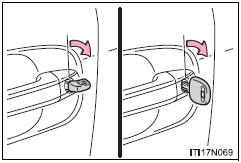
- The doors are unlocked using the key.
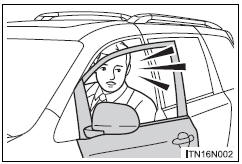
- A person inside the vehicle opens a door or hood.
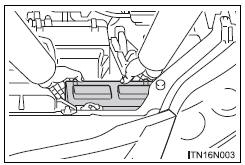
- The battery is recharged or replaced when the vehicle is locked. (
Alarm-operated door lock
In the following cases, depending on the situations, the door may automatically lock to prevent improper entry into the vehicle:
- When a person left in the vehicle triggers the alarm by unlocking a door or the back door.
- When a person left in the vehicle unlocks a door or the back door while the alarm is operating.
- When recharging or replacing the battery.
| NOTICE To ensure the system operates correctly Do not modify or remove the system. If modified or removed, the proper operation of the system cannot be guaranteed. |
 Setting the alarm system
Close the doors and hood, and
lock all the doors using the entry
function or wireless remote control.
The system will be set automatically
after 30 seconds.
The indicator light changes fr ...

Other materials:
Fastening the seat belt (for the third center seat)
Take the plate out of the holder,
and then pull down the seat
belt.
Push plate “A� into buckle “A�
until a click sound is heard.
Push plate “B� into buckle “B�
until a click sound is heard.
...
Preparation 2gr-fe cooling
SST
RECOMMENDED TOOLS
EQUIPMENT
COOLANT
Capacity
Classification
11.3 liters (12.0 US qts, 10.0 Imp. qts)
Use only "TOYOTA Super Long Life Coolant" or similar high quality
ethylene glycol based non-silicate, non-amine, non-nitrite, non-borate
coolant ...
System description
1. GENERAL
In conjunction with impact absorbing structure for a
frontal collision, the SRS (Supplemental Restraint
System) driver airbag and front passenger airbag
were designed to supplement seat belts in the event
of a frontal collision in order to help reduce shock to
the head ...
