
Toyota Sienna Service Manual: Installation
1. INSTALL SHOCK ABSORBER ASSEMBLY REAR LH
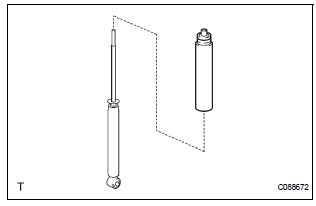
(a) Install the rear spring bumper No.1 LH to the shock absorber assembly LH.
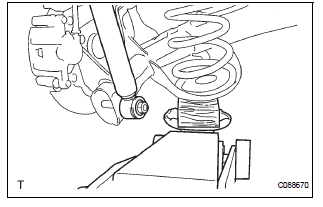
(b) Support the rear axle beam assembly with a jack.
(c) Install the rear shock absorber assembly rear LH, cushion retainer and nut to the rear axle beam.
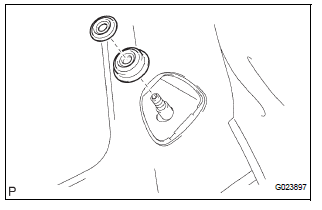
(d) Install the rear shock absorber cushion No.1 and rear shock absorber LH cushion retainer.
(e) Temporary tighten a new lock nut.
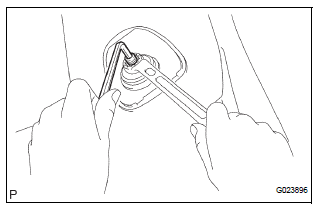
(f) Using a 6mm hexagon wrench to hold the piston rod, fully tighten the lock nut.
Torque: 30 N*m (310 kgf*cm, 22 ft.*lbf)
2. INSTALL REAR SHOCK ABSORBER CAP LH
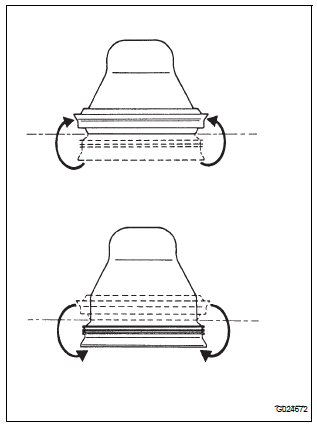
(a) Install the shock absorber cap LH as shown in the illustration.
(b) Install the shock absorber head cover.
3. INSTALL REAR WHEEL
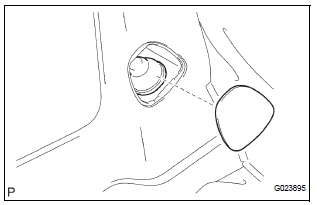
Torque: 103 N*m (1,050 kgf*cm, 76 ft.*lbf)
4. FULLY TIGHTEN SHOCK ABSORBER ASSEMBLY REAR LH
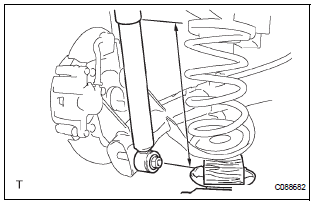
(a) Stabilize the shock absorber assembly rear LH.
If it is impossible to tighten the nut at this position, support the rear axle beam with a jack and load the rear compartment with a mass of approximately 90 kg (198 lb).
Length of shock absorber: 2WD DRIVE TYPE: 234 mm (9.22 in.) 4WD DRIVE TYPE: 258 mm (10.16 in.)
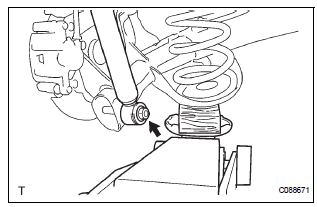
(b) Fully tighten the nut.
Torque: 115 N*m (1,173 kgf*cm, 85 ft.*lbf)
5. INSPECT REAR WHEEL ALIGNMENT
HINT: (See page SP-9)
 Inspection
1. INSPECT SHOCK ABSORBER ASSEMBLY REAR LH
(a) Push down and pull up the shock absorber rod, and
check that there is no unusual resistance or unusual
operation sound.
If there is any malfunc ...
 Disposal
1. DISPOSE OF SHOCK ABSORBER ASSEMBLY REAR LH
(a) Fully extend the shock absorber rod.
(b) Using a drill, make a hole in the cylinder as shown in
the illustration to discharge the gas inside ...
Other materials:
Distance Control ECU Communication Stop Mode
DESCRIPTION
Detection Item
Symptom
Trouble Area
Distance Control ECU
Communication Stop
Mode
Distance control" is not displayed on the
"Communication Bus Check" screen of the
intelligent tester
Applies to "Distance ...
Cold Start Idle Air Control System Performance
DTC P050A Cold Start Idle Air Control System Performance
DESCRIPTION
This monitor will run when the engine is started at -10 to 50C (14 to 122F)
of the engine coolant
temperature. The DTC will set after the engine idling for 13 seconds (2 trip
detection logic).
The DTC is designed to monit ...
Disassembly
1. REMOVE PARKING BRAKE PEDAL BRACKET PROTECTOR
(a) Using a flat-head screwdriver, disengage the 2
claws on the parking brake pedal bracket protector.
(b) Turning the parking brake pedal bracket protector
clockwise, remove the parking brake pedal bracket
protector from the parking brake ...
