
Toyota Sienna Service Manual: Mute Signal Circuit between Radio Receiver and Television Display Assembly
DESCRIPTION
The radio receiver controls the volume according to the MUTE signal from the television display assembly.
The MUTE signal is sent to reduce noise and a popping sound generated when switching the mode, etc.
If there is an open in the circuit, noise can be heard from the speakers when changing the sound source.
If there is a short in the circuit, even though the radio receiver is normal, no sound or, only an extremely small sound, can be produced.
WIRING DIAGRAM
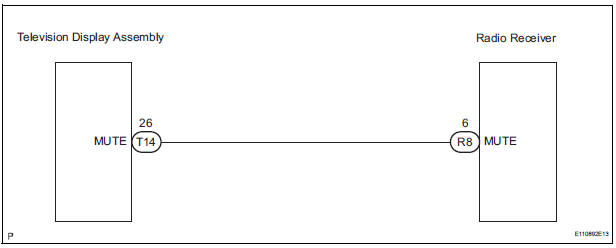
INSPECTION PROCEDURE
1 INSPECT TELEVISION DISPLAY ASSEMBLY

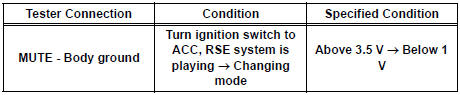
- Measure the voltage according to the value(s) in the table below.
Standard voltage
2 CHECK HARNESS AND CONNECTOR (RADIO RECEIVER - TELEVISION DISPLAY)
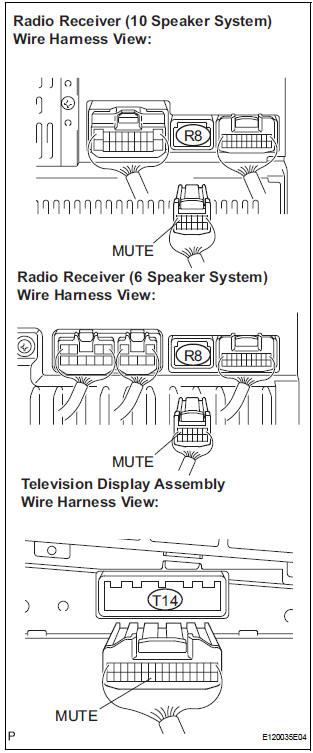
- Disconnect the radio receiver connector R8 and television display assembly connector T14.
- Measure the resistance according to the value(s) in the table below.
Standard resistance

3 REPLACE TELEVISION DISPLAY ASSEMBLY
- Replace the television display assembly and check if the audio system operates normally.
OK: The audio system operates normally
REPLACE RADIO RECEIVER
 Mute Signal Circuit between Radio Receiver and Stereo Component
Amplifier
Mute Signal Circuit between Radio Receiver and Stereo Component
Amplifier
DESCRIPTION
This circuit sends a signal to the stereo component amplifier to mute noise.
Because of that, the noise
produced by changing the sound source ceases.
If there is an open in the circ ...
 AVC-LAN Circuit
DESCRIPTION
Each unit of the audio system connected to the AVC-LAN (communication bus)
transfers the signal of
each switch by communication.
When a short to +B or short to ground occurs in this ...
Other materials:
Rear Occupant Classification Sensor RH Circuit
Malfunction
DTC B1783 Rear Occupant Classification Sensor RH Circuit
Malfunction
DESCRIPTION
The rear occupant classification sensor RH circuit consists of the occupant
classification ECU and the
rear occupant classification sensor RH.
DTC B1783 is recorded when a malfunction is detected in the rear oc ...
Power Slide Door LH does not Operate When Satellite Switch is
Pressed
DESCRIPTION
The power slide door operates only when the power slide door main
switch is ON (switch free: orange
paint on the top of the switch appears). The power slide door ECU LH
controls the power slide door LH,
which activates the slide door motor to open / close the slide do ...
Sensor signal check by test mode (signal check) (when using intelligent
tester)
(a) When having replaced the skid control ECU and/or
yaw rate and deceleration sensor, perform zero
point calibration of the yaw rate and deceleration
sensor.
HINT:
If the ignition switch is turned from the ON
position to the ACC or off during test mode
(signal check), DTCs of the signal ...
