
Toyota Sienna Service Manual: On-vehicle inspection
1. INSPECT BRAKE BOOSTER
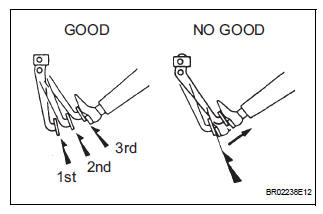
(a) Air tightness check.
(1) Start the engine and stop it after 1 or 2 minutes.
Depress the brake pedal several times slowly.
HINT: If the pedal goes down farthest at the 1st time, and gradually rises at the 2nd or 3rd time, the booster is airtight.
(2) Depress the brake pedal while the engine is running, and stop the engine with the pedal depressed.
HINT: If there is no change in the pedal reserve distance after holding the pedal for 30 seconds, the booster is airtight.
(b) Operating check.
(1) Depress the brake pedal several times with the ignition switch OFF and check that there is no change in the pedal reserve distance.
(2) Depress the brake pedal and start the engine.
HINT: If the pedal goes down slightly, the operation is normal.
 Brake booster
COMPONENTS
...
 Removal
NOTICE:
Do not adjust the brake booster push rod.
Do not change the combination of the diameter
converting unit and brake.
1. REMOVE FRONT WHEEL
2. DRAIN BRAKE FLUID
NOTICE:
Wash the bra ...
Other materials:
ABS Warning Light Remains ON
DESCRIPTION
If any of the following is detected, the ABS warning light remains on.
The skid control ECU connectors are disconnected from the skid control
ECU.
There is a malfunction in the skid control ECU internal circuit.
There is an open in the harness between the combination meter an ...
How to proceed with
troubleshooting
1 VEHICLE BROUGHT TO WORK SHOP
2 CUSTOMER PROBLEM ANALYSIS
3 CHECK BODY MULTIPLEX COMMUNICATION SYSTEM
Check for the DTC outputs.
4 DTC CHECK
5 DTC CHART
6 PROBLEM SYMPTOMS TABLE
7 TERMINAL OF ECU
8 CIRCUIT INSPECTION
9 IDENTIFICATION OF PROBLEM
10 REPAIR OR REPLACE
11 CONFIRMATION T ...
SM Solenoid Circuit
DTC C1225/25 SM Solenoid Circuit
DESCRIPTION
This solenoid turns on when receiving signals the ECU and controls the
pressure acting on the wheel
cylinders to control the braking force.
WIRING DIAGRAM
Refer to DTCs C0226/21, C0236/22, C0246/23 and C0256/24 (See page BC-105).
INSPECTION PR ...
