
Toyota Sienna Service Manual: Removal
1. Remove v-bank cover sub-assembly (see page em-28) 2. Remove front wheel rh 3. Remove no. 1 Engine under cover (see page em-26) 4. Remove front fender apron seal rh (see page em-26) 5. Drain engine coolant (see page co-6) 6. Remove no. 2 Air cleaner inlet (see page em- 28) 7. Remove battery (see page em-26) 8. Remove front bumper assembly (see page et-3) 9. Remove front bumper energy absorber 10. Remove no. 1 Air cleaner inlet (see page em- 28) 11. Disconnect radiator reserve tank hose or pipe (see page co-28) 12. Disconnect no. 1 Radiator hose (see page co- 28) 13. Disconnect no. 2 Radiator hose (see page co- 29) 14. Remove hood lock release lever protector (see page co-29) 15. Remove hood lock assembly (see page co-29) 16. Remove hood lock support sub-assembly (see page co-29) 17. Disconnect cooling fan ecu connector (see page co-30) 18. Remove radiator upper support subassembly (see page co-30) 19. Disconnect no. 2 Oil cooler outlet tube sub-assembly (see page co-31) 20. Remove headlight assembly rh (see page li- 69)
21. Remove radiator side deflector rh (see page co-31) 22. Remove headlight bracket rh (see page co- 32) 23. Remove pressure feed tube assembly (see page co-32)
24. REMOVE RADIATOR SUPPORT CUSHION (See page CO-32) 25. REMOVE NO. 1 RADIATOR SUPPORT (See page CO- 32) 26. REMOVE RADIATOR ASSEMBLY WITH FAN SHROUD AND FAN MOTOR (See page CO-33) 27. REMOVE V-RIBBED BELT (See page EM-6) 28. REMOVE GENERATOR ASSEMBLY
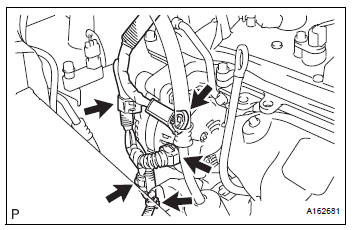
(a) Remove the terminal cap.
(b) Remove the nut and disconnect the wire harness from terminal B.
(c) Disconnect the generator connector from the generator assembly.
(d) Disconnect the connector from the compressor and magnetic clutch.
(e) Disconnect the 2 wire harness clamps.
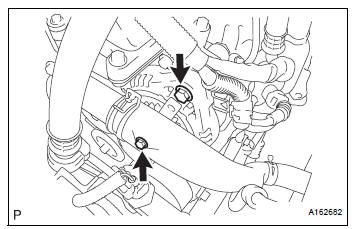
(f) Remove the 2 bolts.
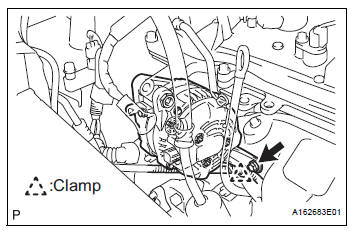
(g) Remove the bolt from the cylinder block.
(h) Disconnect the wire harness clamp and remove the generator assembly.
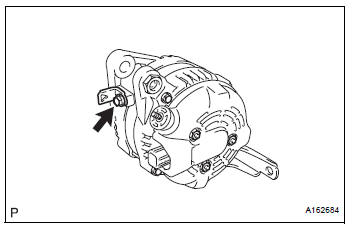
(i) Remove the bolt and wire harness clamp stay.
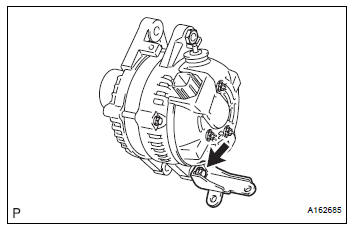
(j) Remove the bolt and bracket.
 Components
...
 Disassembly
1. REMOVE GENERATOR CLUTCH PULLEY
(A) using a screwdriver, remove the generator pulley
cap.
(b) Set SST (A) and (B).
SST 09820-63020
(c) Clamp SST (A) in a vise.
NOTICE:
...
Other materials:
Listening to an iPod
Connecting an iPod enables you to enjoy music from the vehicle
speakers.
Select “iPod� on the audio source selection screen.
When the iPod connected to the system includes iPod video, the
system can only output the sound by selecting the browse
screen.
Connecting an iPod
Audio control ...
Brake Warning Light does not Come ON
WIRING DIAGRAM
See page BC-52.
INSPECTION PROCEDURE
1 INSPECT BRAKE WARNING LIGHT
(a) Disconnect the skid control ECU connector.
(b) Turn the ignition switch to the on position.
(c) Check that the BRAKE warning light comes on.
OK:
BRAKE warning light comes on.
HINT:
If troubleshooting ...
Short to GND in Curtain Shield Squib RH Circuit
DTC B1162/81 Short to GND in Curtain Shield Squib RH Circuit
DESCRIPTION
The curtain shield squib RH circuit consists of the center airbag sensor
assembly and the curtain shield
airbag assembly RH.
The circuit instructs the SRS to deploy when deployment conditions are met.
DTC B1162/81 is ...
