
Toyota Sienna Service Manual: Reassembly
1. APPLY HIGH TEMPERATURE GREASE
(a) Apply the high temperature grease to the surface on which the shoe and backing plate attach.
2. INSTALL PARKING BRAKE SHOE LEVER LH
(a) Install the shoe lever and shim to the rear shoe with a new C-washer.
(b) Using a feeler gauge, measure the clearance.
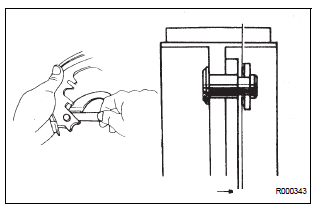
Standard clearance: Less than 0.35 mm (0.0138 in.)
If the clearance is not within the specification,
replace the shim with one of the correct size.

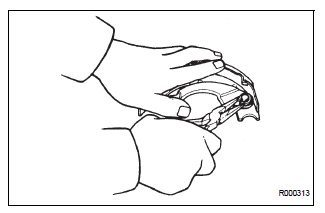
(c) Install the correct side shim with a new C-washer.
(d) Remeasure the clearance.
3. INSTALL PARKING BRAKE SHOE ASSEMBLY LH NO.2
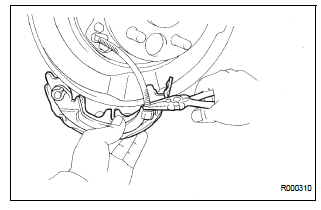
(a) Using needle-nose pliers, connect the parking brake cable No. 3 to the parking brake shoe lever.
(b) Install the parking brake shoe assembly LH No. 2 with the shoe hold-down compression spring pin No. 2, shoe hold-down compression spring and 2 cups.
4. INSTALL PARKING BRAKE SHOE ADJUSTING SCREW SET
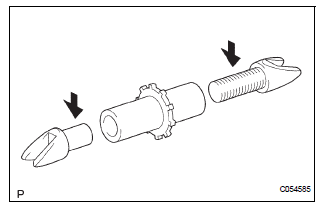
(a) Apply the high temperature grease to the adjusting bolt.
(b) Install the parking brake shoe adjusting screw set LH.
5. INSTALL PARKING BRAKE SHOE STRUT LH
6. INSTALL PARKING BRAKE SHOE ASSEMBLY LH NO.1
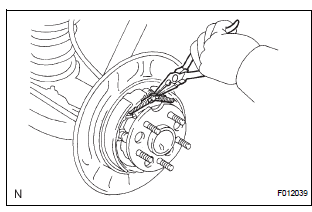
(a) Install the parking brake shoe assembly LH No. 1 with the shoe hold-down compression spring pin No. 1, shoe hold-down compression spring and 2 cups.
(b) Install the tension spring and 2 shoe return tension springs.
7. CHECK PARKING BRAKE INSTALLATION
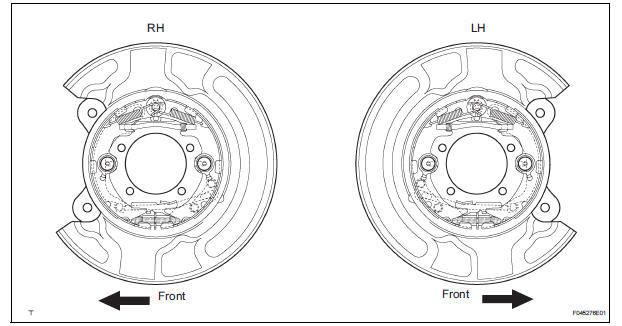
(a) Check that each part is installed properly.
NOTICE: No oil or grease should be adhered to the friction surface of the shoe lining and disc.
8. INSTALL REAR DISC
9. ADJUST PARKING BRAKE SHOE CLEARANCE
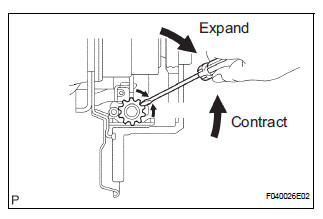
(a) Temporarily install the hub nuts.
(b) Remove the hole plug, and turn the adjuster and expand the shoes until the disc locks.
(c) Contract the shoe adjuster until the disc can rotate smoothly.
Standard: Return 8 notches
(d) Check that the brake disc rotates smoothly.
(e) Install the hole plug.
10. CONNECT REAR DISC BRAKE CALIPER ASSEMBLY LH
11. INSTALL REAR WHEEL Torque: 103 N*m (1,050 kgf*cm, 76 ft.*lbf)
12. INSPECT PARKING BRAKE PEDAL TRAVEL (See page PB-1)
13. ADJUST PARKING BRAKE PEDAL TRAVEL (See page PB-1)
 Inspection
1. INSPECT BRAKE DISC INSIDE DIAMETER
(a) Using a brake drum gauge or equivalent, measure
the inside diameter of the disc.
Standard inside diameter:
190 mm (7.480 in.)
Maximum inside diameter ...
Other materials:
Removal
1. REMOVE INSTRUMENT PANEL SUB-ASSEMBLY WITH PASSENGER AIRBAG ASSEMBLY
HINT:
Refer to the instructions for removal of the instrument
panel sub-assembly w/ passenger airbag assembly (See
page IP-5).
2. REMOVE HEATER TO FOOT DUCT NO.1
(a) Remove the clip and the heater to foot duct No. 1.
3 ...
System description
1. SYSTEM DESCRIPTION
(a) The ECT (Electronic controlled automatic
transmission/transaxle) is an automatic
transmission/transaxle that electronically controls
shift timing using the ECM. The ECM detects
electrical signals that indicate engine and driving
conditions, and controls the shift poin ...
Power slide door control motor and clutch
INSPECTION
1. INSPECT SLIDE DOOR CONTROL MOTOR AND CLUTCH ASSEMBLY LH
Remove the motor and clutch.
Connect the battery positive (+) lead to terminal 3
and the battery negative (-) lead to terminal 2.
Apply battery voltage to the terminals and check the
motor operation.
OK
If ...
