
Toyota Sienna 2010-2026 Owners Manual: Battery
Check the battery as follows:
Battery exterior
Make sure that the battery terminals are not corroded and that there are no loose connections, cracks, or loose clamps.
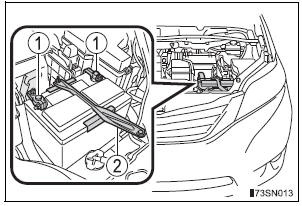
- Terminals
- Hold-down clamp
Before recharging
When recharging, the battery produces hydrogen gas which is flammable and explosive. Therefore, observe the following before recharging:
- If recharging with the battery installed on the vehicle, be sure to disconnect the ground cable.
- Make sure the power switch on the charger is off when connecting and disconnecting the charger cables to the battery.
After recharging/reconnecting the battery (vehicles with a smart key system)
- Unlocking the doors using the smart key system may not be possible immediately after reconnecting the battery. If this happens, use the wireless remote control or the mechanical key to lock/unlock the doors.
- Start the engine with the engine switch in ACCESSORY mode. The engine may not start with the engine switch turned off. However, the engine will operate normally from the second attempt.
- The engine switch mode is recorded by the vehicle. If the battery is
reconnected,
the vehicle will return the engine switch mode to the status it was in
before the battery was disconnected. Make sure to turn off the engine
before disconnecting the battery. Take extra care when connecting the
battery
if the engine switch mode prior to discharge is unknown.
If the system will not start even after multiple attempts, contact your Toyota dealer.
Disconnecting the battery (vehicles with an AUTO ACCESS SEAT)
Do not disconnect the battery while operating the AUTO ACCESS SEAT. The AUTO ACCESS SEAT will become inoperable.
For details, refer to “AUTO ACCESS SEAT OWNER’S MANUAL�.
| WARNING Chemicals in the battery Batteries contain poisonous and corrosive sulfuric acid and may produce hydrogen gas which is flammable and explosive. To reduce the risk of death or serious injury, take the following precautions while working on or near the battery:
Where to safely charge the battery Always charge the battery in an open area. Do not charge the battery in a garage or closed room where there is insufficient ventilation. How to recharge the battery Only perform a slow charge (5 A or less). The battery may explode if charged at a quicker rate. Emergency measures regarding electrolyte
|
| NOTICE When recharging the battery Never recharge the battery while the engine is running. Also, be sure all accessories are turned off. |
 Brake fluid
Checking fluid level
The brake fluid level should be
between the “MAX� and “MIN�
lines on the tank.
“MAX� line
“MIN� line
Adding fluid
Lift the cover off.
Make su ...
 Washer fluid
If any washer does not work or the
warning message appears on the
multi-information display, the
washer tank may be empty. Add
washer fluid.
WARNINGWhen refilling washer fluid
Do no ...
Other materials:
Bulb locations
Front
Vehicles without daytime running lights or with bulb type daytime
running lights
Headlight high beam and daytime
running lights (if equipped)
Headlight low beam
(halogen bulb)
Fog light (if equipped)
Front turn signal/parking and
front side marker lights
Vehic ...
Eject Error/ Elevator Error/ Clamp Error/ Eject Error/ Elevator Error/ Clamp
Error
DTC 62-45 Eject Error
DTC 62-51 Elevator Error
DTC 62-52 Clamp Error
DTC 63-45 Eject Error
DTC 63-51 Elevator Error
DTC 63-52 Clamp Error
DESCRIPTION
DTC No.
DTC Detecting Condition
Trouble Area
62-45
Disc cannot be ejected.
Radio receiver
62-5 ...
Removal
1. DISCONNECT CABLE FROM NEGATIVE BATTERY
TERMINALV
Caution:
wait at least 90 seconds after disconnecting the
cable from the negative (-) battery terminal to
prevent airbag and seat belt pretensioner activation.
2. Remove air fuel ratio sensor (for bank 2
sensor 1)
(a) ...
