
Toyota Sienna Service Manual: Check and replace ecu
• When no measuring condition is specified, perform the inspection with the engine stopped and the ignition switch on.
• Check that the connectors are fully seated. Check for loose, corroded or broken wires.
(a) First, check the ECU ground circuit. If it is faulty, repair it. If it is normal, the ECU could be faulty.
Temporarily replace the ECU with a normally functioning one and check if the symptoms occur. If the trouble symptoms disappear, replace the original ECU.
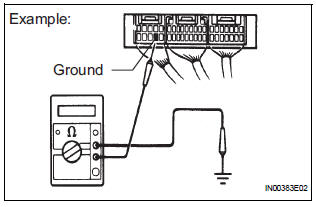
(1) Measure the resistance between the ECU ground terminal and body ground.
Standard resistance: Below 1 Ω
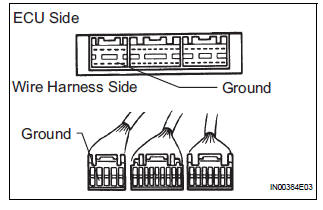
(2) Disconnect the ECU connector. Check the ground terminal on the ECU side and wire harness side for bending, corrosion or foreign matter. Lastly, check the contact pressure of the female terminals.
 Check for short circuit
(a) If the wire harness is ground shorted (Fig. 5), locate the section by
conducting a resistance check with the body ground (below).
(b) Check the resistance with the body ground.
...

Other materials:
Inspection
1. INSPECT INVERTER MAIN SWITCH
Inspect the continuity between terminal at the each
switch position shown in the chart.
If continuity is not as specified, replace the main
switch assembly.
Inspect the bulb state when connecting the battery
to each terminal
...
Using a Bluetooth®
Phone
The hands-free system is a function that allows you to use your
cellular phone without touching it.
This system supports Bluetooth®. Bluetooth® is a wireless data
system that allows the cellular phone to wirelessly connect to
the hands-free system and make/receive calls.
Before making a p ...
Write vin
(a) The VIN writing process is shown in the flowchart
below. This process allows the VIN to be input into
the ECM. If the ECM is changed, or the ECM VIN
and Vehicle VIN do not match, the VIN can be
registered, or overwritten in the ECM by following
this procedure.
(b) Write VIN using the int ...
