
Toyota Sienna Service Manual: Disassembly
1. REMOVE 2ND BRAKE PISTON RETURN SPRING SUB-ASSEMBLY
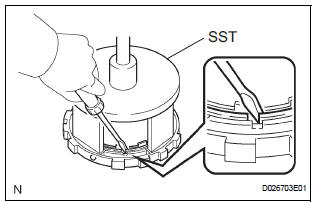
(a) Place SST on the return spring and compress the return spring with a press.
SST 09387-00060
(b) Using a screwdriver, remove the snap ring.
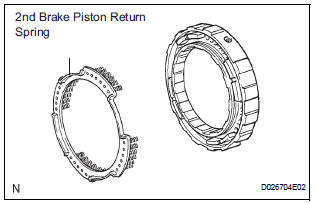
(c) Remove the 2nd brake piston return spring.
2. REMOVE 2ND BRAKE PISTON
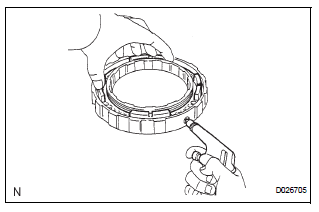
(a) Hold the 2nd brake piston and apply compressed air (392 kPa, 4.0 kgf/cm2, 57 psi) to the 2nd brake cylinder to remove the 2nd brake piston.
NOTICE: Hold the piston with a shop rag or a piece of cloth when removing the piston. Failure to do so may result in the piston jumping out from the cylinder.
3. REMOVE 2ND BRAKE PISTON O-RING
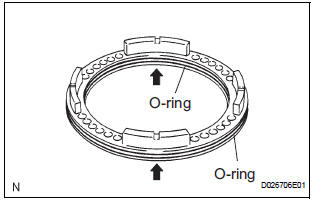
(a) Remove the 2 O-rings from the 2nd brake piston.
 Second brake piston
COMPONENTS
...
 Inspection
1. INSPECT 2ND BRAKE PISTON RETURN SPRING
SUB-ASSEMBLY
(a) Using vernier calipers, measure the free length of
the spring together with the spring seat.
Standard free length:
16.61 mm (0.6539 ...
Other materials:
Removal
1. BOLT, SCREW AND NUT TABLE
The bolts, the screws and the nuts, which are
necessary for installation and removal of the
instrument panel are shown in the illustration below
with alphabets.
2. DISCONNECT BATTERY NEGATIVE TERMINAL
3. REMOVE STEERING WHEEL COVER LOWER NO.2
4. ...
Adjustment procedure
Second seat
Tip-up seat (7-passenger models)
Seat position adjustment
lever
Seatback angle adjustment
lever
Tip-up seat (8-passenger models)
Seat position adjustment
lever
Seatback angle adjustment
lever
Ottoman seat
Seat position adjustment
...
Problem symptoms table
HINT:
Use the table below to help determine the cause of the
problem symptom. The likely causes of the problem are
indicated in descending order. Check each suspected area
in order. Repair or replace faulty parts or perform
adjustments as necessary.
Inspect the fuse and rel ...
