
Toyota Sienna Service Manual: Disassembly
1. INSPECT PACK CLEARANCE OF REVERSE CLUTCH
HINT: (See page AX-249)
2. INSPECT PACK CLEARANCE OF DIRECT CLUTCH AND OVERDRIVE CLUTCH
HINT: (See page AX-249)
3. REMOVE DIRECT MULTIPLE DISC CLUTCH DISC
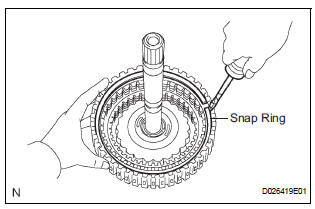
(a) Using a screwdriver, remove the snap ring from the intermediate shaft.
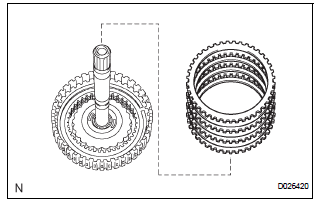
(b) Remove the flange, 3 discs, 3 plates and cushion plate from the intermediate shaft.
4. REMOVE OVERDRIVE DIRECT CLUTCH DISC
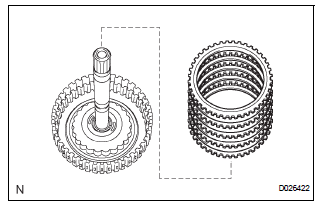
(a) Using a screwdriver, remove the snap ring from the intermediate shaft.
(b) Remove the flange, 4 discs and 4 plates from the intermediate shaft.
5. REMOVE OVERDRIVE CLUTCH RETURN SPRING SUB-ASSEMBLY
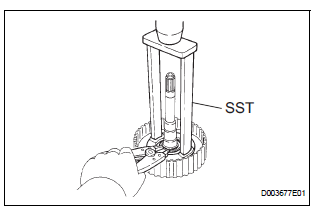
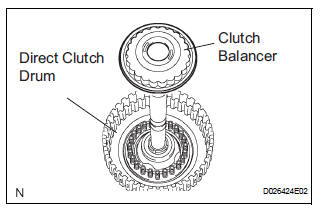
(a) Place SST on the clutch balancer and compress the spring with a press.
SST 09387-00020
(b) Using a snap ring expander, remove the snap ring from the direct clutch drum.
NOTICE:
- Stop the press when the spring seat is lowered to the place 1 to 2 mm (0.039 to 0.078 in.) from the snap ring groove.
- This prevents the spring seat from being deformed.
- Do not expand the snap ring excessively.
- This prevents the spring seat from being deformed.
- Do not expand the snap ring excessively.
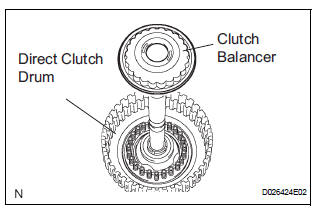
(c) Remove the clutch balancer from the direct clutch drum.
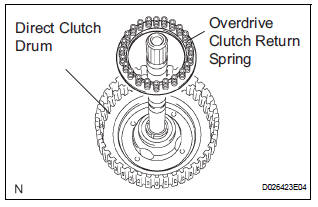
(d) Remove the overdrive clutch return spring from the direct clutch drum.
6. REMOVE OVERDRIVE DIRECT CLUTCH PISTON
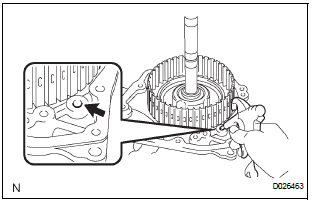
(a) Install the intermediate shaft on the transaxle rear cover.
(b) Holding the direct clutch piston with your hand, apply compressed air (392 kPa, 4.0 kgf/cm2, 57 psi) to the transaxle rear cover to remove the direct clutch piston.
7. REMOVE OVERDRIVE DIRECT CLUTCH DRUM SUBASSEMBLY
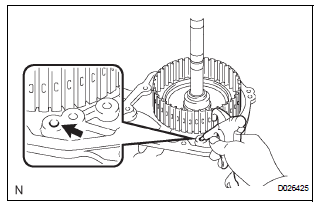
(a) Holding the direct clutch drum by hand, apply compressed air (392 kPa, 4.0 kgf/cm2, 57 psi) to the transaxle rear cover to remove the direct clutch drum.
8. REMOVE OVERDRIVE DIRECT CLUTCH O-RING
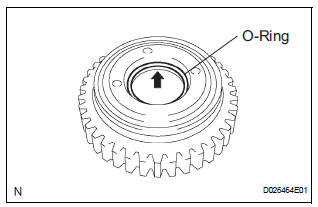
(a) Using a screwdriver, remove the O-ring from the direct clutch drum.
 Direct clutch
Components
...
 Inspection
1. Inspect pack clearance of reverse clutch
(A) install the intermediate shaft and needle roller
bearing onto the transaxle rear cover.
(B) using a dial indicator, measure the reverse clutch
...
Other materials:
Approach warning
When your vehicle is too close to a vehicle ahead, and sufficient automatic
deceleration via the cruise control is not possible, the display
will flash and the buzzer will sound to alert the driver. An example of
this would be if another driver cuts in front of you while you are following
a vehi ...
Diagnostic trouble code chart
If a malfunction code is displayed during the DTC check,
check the circuit listed for that code in the chart below
(Proceed to the page given for that circuit).
MULTIPLEX COMMUNICATION SYSTEM
DTC Code
Detection Item
Trouble Area
B1200
MPX Body ECU Stop
...
Reassembly
1. INSTALL OIL PUMP COVER
(a) Coat the drive and driven rotors with engine oil and
place them into the timing chain cover with the
marks facing outward (oil pump cover side). Check
that the rotors rotate smoothly.
(b) Install the oil pump cover with the 8 bolts.
Torque: 9.1 N*m (93 kgf ...
