
Toyota Sienna Service Manual: Inspection
1. INSPECT TIRES
(a) Check the tires for wear and proper inflation pressure.
Cold tire inflation pressure 
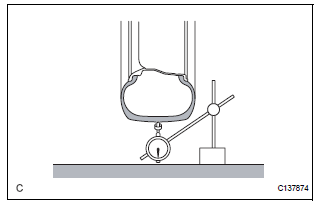
(b) Using a dial indicator, check the runout of the tires.
Tire runout: 1.4 mm (0.055 in.) or less
2. ROTATE TIRES
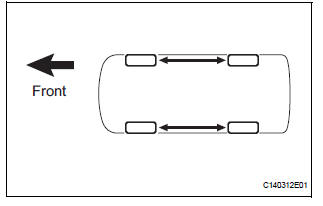
HINT: Rotate the tires as shown in the illustration.
3. INSPECT WHEEL BALANCE (for Steel Wheel)
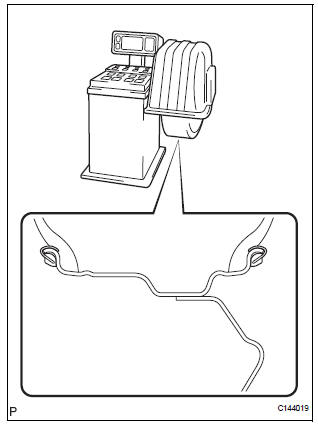
(a) Check and adjust the off-the-car balance.
Imbalance after adjustment: 8.0 g (0.018 lb.) or less.
HINT: If necessary, check and adjust the on-the-car balance.
4. INSPECT WHEEL BALANCE (for Non-steel Wheel)
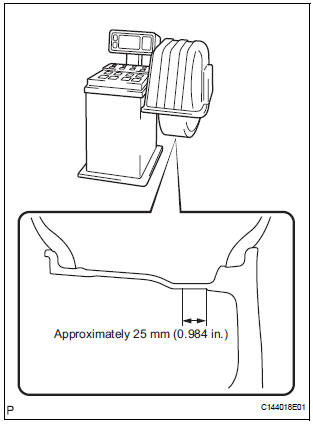
(a) Check and adjust the off-the-car balance.
Imbalance after adjustment: 8.0 g (0.018 lb.) or less.
NOTICE:
- Use a cleaning detergent to remove dirt, oil and water from the surface where the balance weight is to be adhered.
- Do not touch the sticking surface of the tape.
- Adhere the sticking type balance weight to the flat position shown in the illustration.
- Push the balance weight securely with a finger to adhere it to the position.
- Do not reuse the balance weight.
HINT:
- The inner side balance weight should be installed by clipping it to the rim.
- If necessary, check and adjust the on-the-car balance.
5. INSPECT FRONT AXLE HUB BEARING LOOSENESS
HINT: See page AH-5.
6. INSPECT REAR AXLE HUB BEARING LOOSENESS (for 2WD)
HINT: See page AH-16.
7. INSPECT REAR AXLE HUB BEARING LOOSENESS (for 4WD)
HINT: See page AH-19.
8. INSPECT FRONT AXLE HUB RUNOUT
HINT: See page AH-5.
9. INSPECT REAR AXLE HUB RUNOUT (for 2WD)
HINT: See page AH-16.
10. INSPECT REAR AXLE HUB RUNOUT (for 4WD)
HINT: See page AH-19.
 Problem symptoms table
HINT:
Use the table below to help determine the cause of the
problem. The likely causes of the problem are indicated in
descending order. Check each suspected area in order. If
necessary, repair o ...
 Repair
1. INTRODUCTION
(a) This section introduces ways to determine whether
the run-flat tire is repairable or not. Repair must be
performed by following the appropriate procedures.
If a flat tire occ ...
Other materials:
Refrigerant
On-vehicle inspection
1. INSPECT REFRIGERANT PRESSURE WITH MANIFOLD GAUGE SET
(a) This method uses a manifold gauge set to locate
problem areas. Read the manifold gauge pressure
when these conditions are established.
Test conditions:
Temperature at the air inlet is 30 to 35°C (86 to
95 ...
Entire Combination Meter does not Operate
DESCRIPTION
This is the power source circuit to operate the combination meter assembly.
WIRING DIAGRAM
INSPECTION PROCEDURE
1 INSPECT COMBINATION METER ASSEMBLY
Disconnect the C10 connector.
Measure the resistance according to the value(s) in the
table below.
Standard resistan ...
Rear Air Conditioning Relay Circuit
DESCRIPTION
The RR A/C relay is switched on by signals from the A/C amplifier. It
supplies power to the rear blower
motor.
WIRING DIAGRAM
INSPECTION PROCEDURE
1 INSPECT RELAY (RR A/C)
(a) Remove the RR A/C relay from the No. 3 relay block.
(b) Measure the resistance according to t ...
