
Toyota Sienna Service Manual: Disassembly
1. Remove rear wheel
2. Drain brake fluid
Notice: wash the brake fluid off immediately if it attaches to any painted surface.
3. REMOVE REAR BRAKE DRUM SUB-ASSEMBLY
(a) Release the parking brake lever, and remove the rear brake drum.
HINT: If the rear brake drum cannot be removed easily, perform the following procedure.
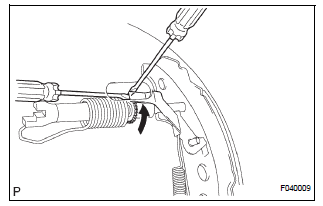
(b) Remove the hole plug and insert a screwdriver through the hole in the backing plate, and hold the automatic adjusting lever away from the adjuster.
(c) Using another screwdriver, reduce the brake shoe adjuster by turning the adjusting wheel.
4. REMOVE FRONT BRAKE SHOE
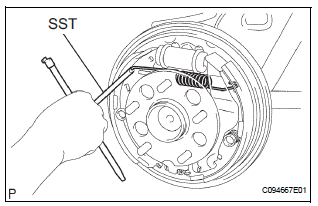
(a) Using SST, remove the shoe return spring from the front brake shoe.
SST 09921-00010
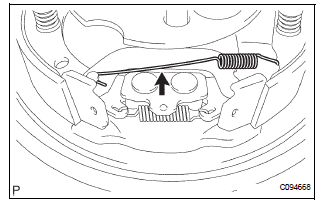
(b) Using a needle-nose pliers, remove the return spring.
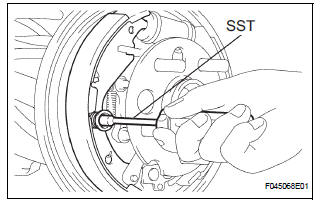
(c) Using SST, remove the shoe hold down spring cup, shoe hold down spring and pin.
SST 09718-00010 (d) Remove the parking brake shoe strut LWR.
(e) Remove the tension spring and front brake shoe.
(f) Remove the automatic adjust lever spring and rear brake automatic adjust lever LH from the front brake shoe.
5. REMOVE REAR BRAKE SHOE
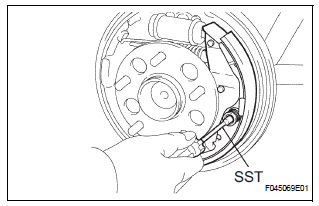
(a) Using SST, remove the shoe hold down spring cup, shoe hold down spring and pin.
SST 09718-00010
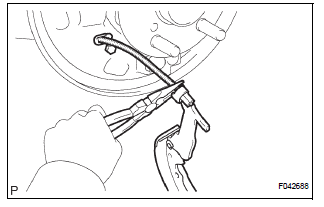
(b) Using a needle-nose pliers, disconnect the parking brake cable No. 3 and remove the rear brake shoe.
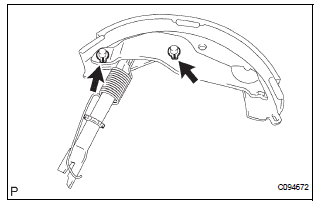
(c) Using a screwdriver, remove the 2 C-washers, parking brake shoe lever, parking brake reaction lever LH and rear brake strut set.
6. REMOVE LH, FRONT OR UPPER REAR WHEEL BRAKE CYLINDER ASSEMBLY
(a) Using SST, disconnect the brake tube, use a container to catch the brake fluid.
SST 09023-00101
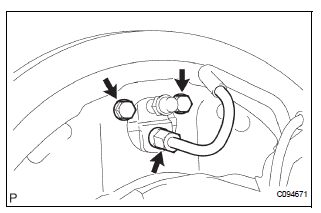
(b) Remove the 2 bolts and rear wheel brake cylinder assembly.
7. REMOVE REAR WHEEL CYLINDER CUP KIT
(a) Remove the 2 cylinder dust boots from the rear wheel brake cylinder assembly.
(b) Remove the 2 pistons and compression spring.
(c) Remove the 2 wheel cylinder cups from each piston.
(d) Remove the bleeder plug cap and bleeder plug from the rear wheel brake cylinder assembly.
 Rear drum brake
Components
...
 Inspection
1. INSPECT BRAKE DRUM INSIDE DIAMETER
(a) Using a brake drum gauge or equivalent, measure
the inside diameter of the drum.
Standard inside diameter:
254.0 mm (10.00 in.)
Maximum inside diamet ...
Other materials:
Diagnosis system
1. DIAGNOSIS FUNCTION
The diagnosis function makes the light and the
multi-information display come on, and the CRUISE
main indicator light blink as shown in the illustration.
When a malfunction occurs in the dynamic laser
cruise control system, the DTCs are stored in the
ECM ...
Dtc check / clear
1. DTC CHECK (NORMAL MODE)
NOTICE:
When the diagnostic system is switched from the
normal mode to the check mode, all the DTCs and
freeze frame data recorded in the normal mode will
be erased. So before switching modes, always check
the DTCs and freeze frame data, and note the ...
Stereo Component Amplifier Power Source Circuit
DESCRIPTION
This circuit provides power to the stereo component amplifier.
WIRING DIAGRAM
INSPECTION PROCEDURE
1 INSPECT STEREO COMPONENT AMPLIFIER
Disconnect the stereo component amplifier connectors.
Measure the resistance according to the values in the
table below.
Standard ...
