
Toyota Sienna Service Manual: Refrigerant
On-vehicle inspection
1. INSPECT REFRIGERANT PRESSURE WITH MANIFOLD GAUGE SET
(a) This method uses a manifold gauge set to locate problem areas. Read the manifold gauge pressure when these conditions are established.
Test conditions:
- Temperature at the air inlet is 30 to 35°C (86 to 95°F).
- Engine is running at 1,500 rpm.
- All doors are fully open.
- Blower speed control switch is at HI.
- Temperature control switch is at MAX. COOL.
- A/C switch is ON.
(b) Gauge readings (Reference)
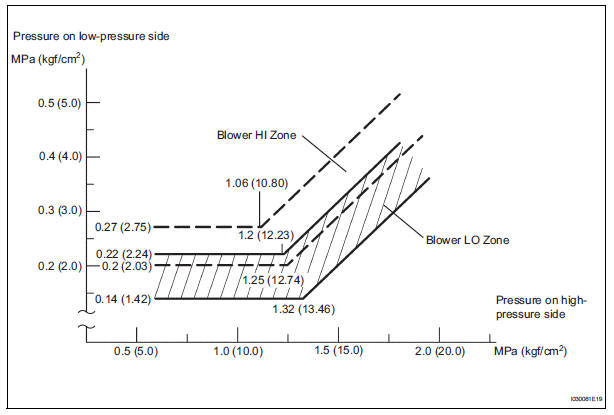
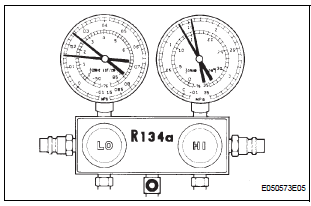
(1) Normally functioning refrigeration system
Gauge reading 
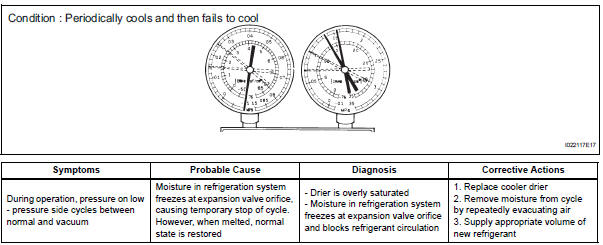
(2) The A/C system periodically changes between normal and improper function due to moisture in the refrigerant system.
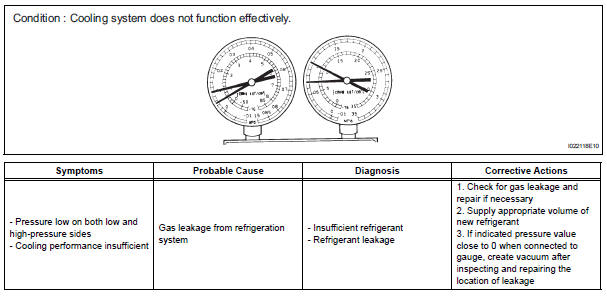
(3) The A/C system does not function effectively due to insufficient cooling.
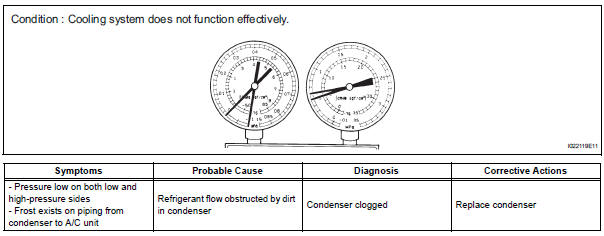
(4) The A/C system does not function effectively due to poor circulation of the refrigerant.
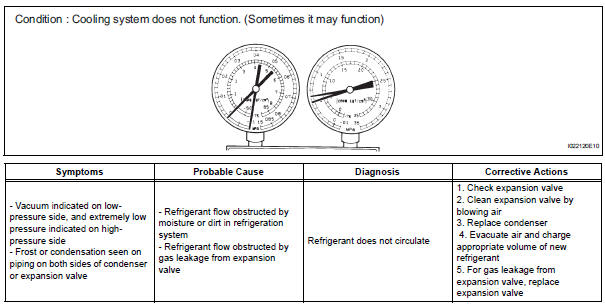
(5) The A/C system does not function intermittently because the refrigerant does not circulate.
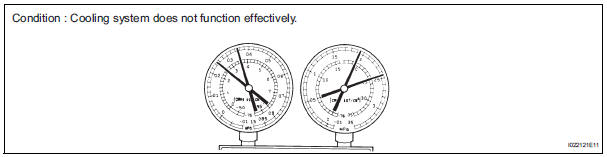
(6) The A/C system does not function effectively due to overcharged refrigerant or insufficient cooling of the condenser.

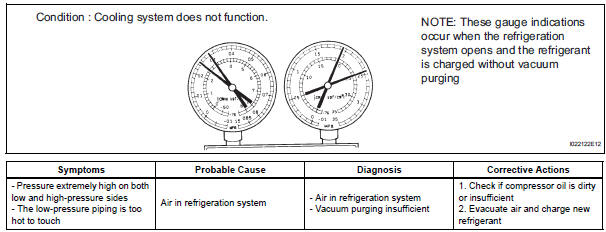
(7) The A/C system does not function due to air in the refrigeration system.
| CAUTION: The low-pressure piping may be very hot and cause serious burns. |
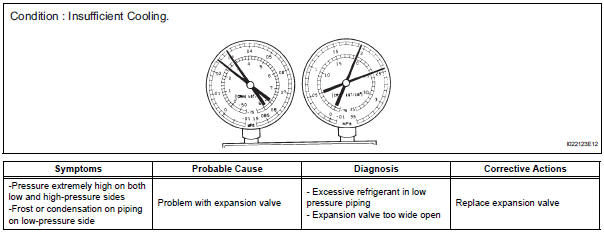
(8) The A/C system does not function effectively due to an expansion valve malfunction.
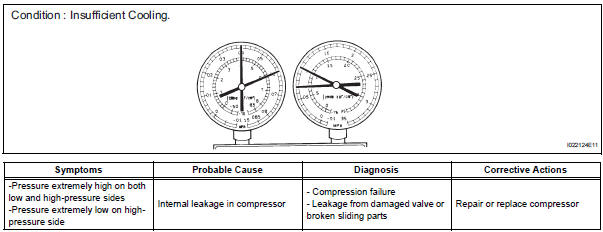
(9) The A/C system does not function due to a defective compressor.
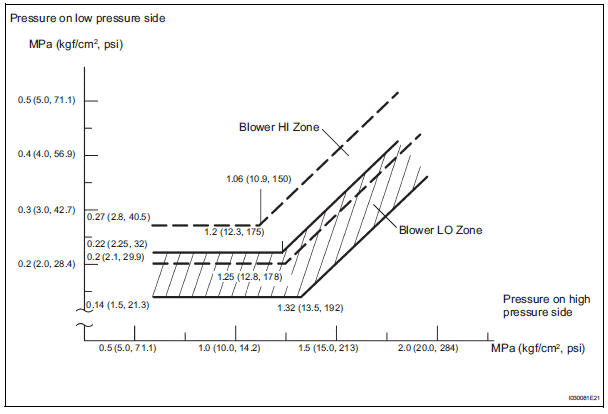
Gauge readings (Reference)
 Terminals of ecu
1. A/C AMPLIFIER
HINT:
Check from the rear of the connector while it is
connected to the A/C amplifier.
(a) Waveform 1:
(b) Waveform 2: ...
 Replacement
1. DISCHARGE REFRIGERANT FROM
REFRIGERATION SYSTEM
SST 07110-58060 (07117-58080, 07117-58090,
07117-78050, 07117-88060, 07117-88070,
07117-88080)
(a) Turn the A/C switch to ON.
(b) Operating t ...
Other materials:
Engine Coolant Temperature / Intake Air Temperature Correlation
DESCRIPTION
The ECM calculates the difference between the readings of the coolant
temperature sensor and intake air
temperature sensor. If the difference is greater than 20°C (68°F), the ECM will
judge this as a malfunction
and will set this DTC.
HINT:
Waiting is required t ...
Removal
1. REMOVE FRONT SEAT INNER BELT ASSEMBLY
HINT:
Refer to the instructions for disassembly of the front seat assembly
(for flat type).
Refer to the instructions for disassembly of the front seat assembly
(for manual seat).
Refer to the instructions for disassembly of the fro ...
Short to B+ in Front Passenger Side Squib Circuit
DTC B0108/52 Short to B+ in Front Passenger Side Squib Circuit
DESCRIPTION
The front passenger side squib circuit consists of the center airbag sensor
assembly and the front
passenger airbag assembly.
The circuit instructs the SRS to deploy when deployment conditions are met.
DTC B0108/52 ...
