
Toyota Sienna Service Manual: Transfer oil
ON-VEHICLE INSPECTION
1. INSPECT TRANSFER OIL
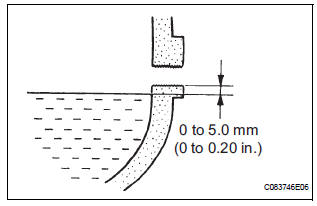
(a) Remove the No. 1 plug and gasket.
(b) Check the oil level is within 0 - 5 mm (0 - 0.20 in.) below the lowest end of the hole for No. 1 plug.
NOTICE:
- When changing oil, recheck the oil level after driving.
- Excessively large or small quantity of oil may cause some trouble.
(c) When the oil level is too low, check for oil leakage.
(d) Tighten the No. 1 plug with a new gasket.
Torque: 49 N*m (500 kgf*cm, 36 ft.*lbf)
2. ADD TRANSFER OIL
(a) Remove the No. 1 plug and gasket and supply oil.
NOTICE:
- When supplying oil, pour it slowly.
- Supply oil several times at several minutes interval.
HINT: The oil level should be within 0 - 5 mm (0 - 0.20 in.) below the lowest end of the hole for the No. 1 plug.
(b) After leaving it alone for 5 minutes, recheck the oil level.
(c) Tighten the No. 5 plug with a new gasket.
Torque: 49 N*m (500 kgf*cm, 36 ft.*lbf)
 Transfer system
PRECAUTION
NOTICE:
1. Before disassembly, clean the transfer assembly of
any sand or mud to prevent it from entering inside the
transfer during disassembly and assembly.
2. When removing any li ...
 Bearing retainer oil seal
COMPONENTS
...
Other materials:
Removal
1. Drain automatic transaxle fluid
(a) Remove the drain plug, gasket and drain ATF.
(b) Install a new gasket and the drain plug.
Torque: 49 N*m (500 kgf*cm, 36 ft.*lbf)
2. Drain transfer oil (for 4wd)
Hint:
(see page tf-8)
3. Remove front wheel
4. REMOVE FRONT AXLE HUB LH NUT
(a) Us ...
Removal
1. REMOVE REAR BUMPER COVER
Put protective tape under the quarter panel.
Partially the fender liner.
HINT:
Do not remove the fender liner completely but
partially so that the bumper cover can be removed.
Remove the 2 screws and 8 clips.
Using a screwdriver, disengage the claws an ...
Gateway ECU Communication Stop Mode
DESCRIPTION
Detection Item
Symptom
Trouble Area
Gateway ECU
Communication Stop
Mode
"Gateway" is not displayed on the "Communication
Bus Check" screen of the intelligent tester
Applies to "Gateway ECU Communication ...
