
Toyota Sienna Service Manual: Disassembly
1. REMOVE RADIATOR WATER INLET
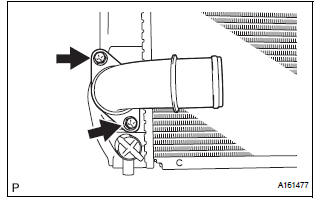
(a) Remove the 2 bolts and radiator water inlet.
2. REMOVE DRAIN PLUG
(a) Remove the drain plug and air drain plug.
(b) Remove the 2 O-rings.
3. REMOVE LOWER RADIATOR TANK
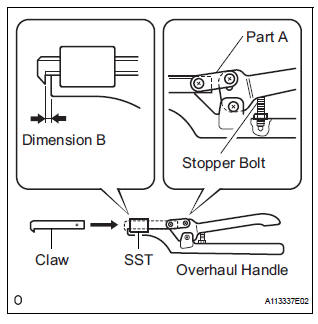
(a) Install the claw to the overhaul handle, inserting it in the hole in Part A as shown in the illustration.
SST 09230-01010 (09231-01010, 09231-01030) (b) While squeezing the handle, adjust the stopper bolt so that dimension B is as specified below.
Dimension B: 0.2 to 0.3 mm (0.008 to 0.012 in.)
| NOTICE: If the stopper bolt is not adjusted, the claw may be damaged. |
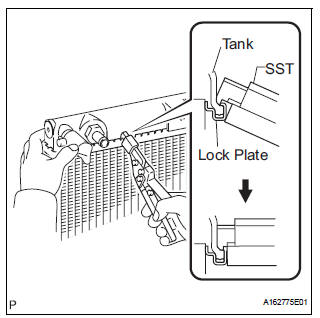
(c) Using SST, uncrimp the lock plate by squeezing the handle until stopped by the stopper bolt.
SST 09230-01010
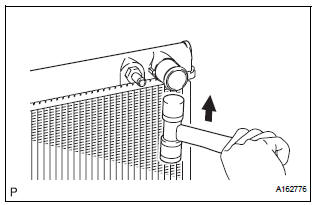
(d) Lightly tap the bracket of the radiator (or radiator hose inlet or outlet) with a soft-faced hammer and remove the tank.
(e) Remove the O-ring.
4. REMOVE UPPER RADIATOR TANK
HINT: The removal procedure for the upper radiator tank is the same as that for the lower radiator tank.
 Removal
1. REMOVE V-BANK COVER SUB-ASSEMBLY (See
page EM-28)
2. REMOVE NO. 1 ENGINE UNDER COVER (See page
EM-26)
3. DRAIN ENGINE COOLANT (See page CO-6)
4. REMOVE NO. 2 AIR CLEANER INLET (See page EM-
2 ...
 Inspection
1. INSPECT LOCK PLATE FOR DAMAGE
(a) Inspect the lock plate for damage.
HINT:
Reassembly of a deformed tank will be
impossible. Therefore, first correct the shape of
the lock plate groov ...
Other materials:
Disassembly
1. REMOVE RH SEAT REAR SEAT RECLINING COVER
Remove the 2 screws.
Remove the RH seat rear seat reclining cover by
pulling it out in the arrow mark direction shown in
the illustration.
2. REMOVE LH SEAT REAR SEAT RECLINING COVER
Remove the 2 screws.
R ...
Grocery bag hooks
The hooks are designed to hang things like a grocery bag.
Type A (front seatback)
(if equipped)
Type B (third seatback)
Type C (luggage compartment)
Type D (luggage compartment)
Pull the hook up.
WARNING
Type C: When not in use, keep the grocery ...
License plate light assembly
COMPONENTS
REMOVAL
1. REMOVE BACK DOOR GARNISH CENTER
2. REMOVE BACK DOOR SIDE GARNISH LH
3. REMOVE BACK DOOR SIDE GARNISH RH
4. REMOVE BACK DOOR STRAP COVER
5. REMOVE BACK DOOR PULL STRAP
6. REMOVE BACK DOOR TRIM BOARD ASSEMBLY
7. REMOVE BACK DOOR GARNISH SUB-ASSEMBLY OUTSIDE
8. RE ...
