
Toyota Sienna Service Manual: Inner rear view mirror
COMPONENTS
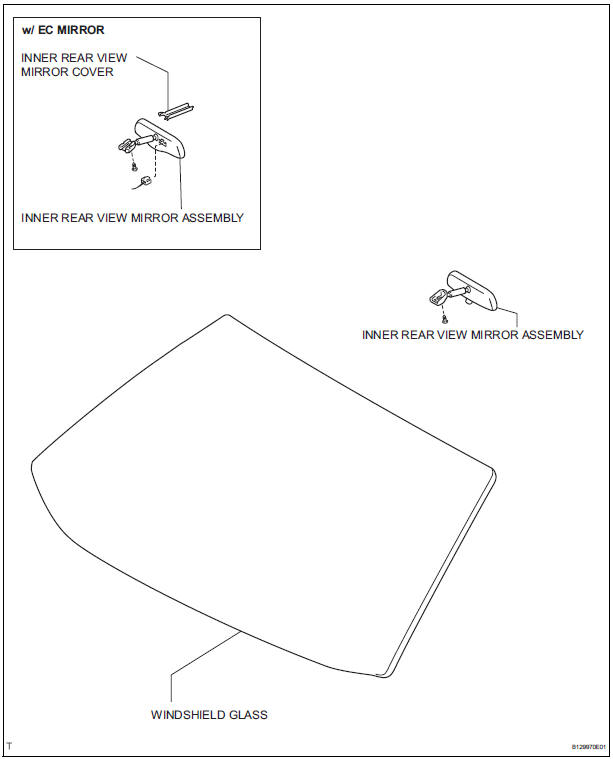
REMOVAL
1. REMOVE INNER REAR VIEW MIRROR ASSEMBLY
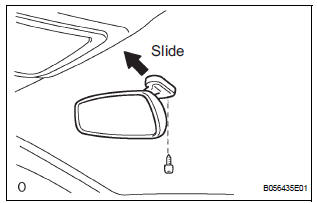
- w/ EC mirror: Remove the inner rear view mirror cover.
- w/ EC mirror: Disconnect the connector.
- Remove the screw.
- Remove the inner rear view mirror assembly as shown in the illustration.
INSPECTION
1. INSPECT INNER REAR VIEW MIRROR ASSEMBLY
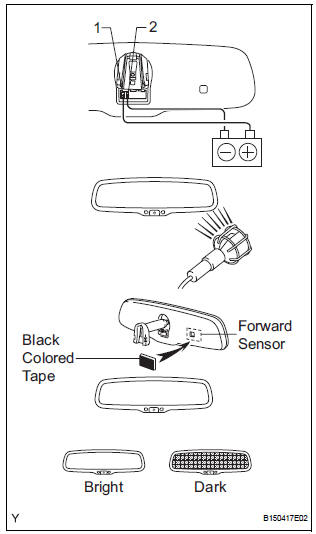
- Inspect operation of the electrochromic inner mirror.
- Connect the positive (+) lead from the battery to terminal 1 and connect the negative (-) lead to terminal 2.
- Attach black colored tape to the forward sensor to prevent it from sensing.
- Light up the mirror with an electric light and check that the mirror surface changes from bright to dark.
Standard: Mirror surface changes from bright to dark
If the result is not as specified, replace the mirror assembly.
INSTALLATION
1. INSTALL INNER REAR VIEW MIRROR ASSEMBLY
 Power mirror control system (w/o Memory)
PARTS LOCATION
Problem symptoms table
POWER MIRROR CONTROL SYSTEM
Symptom
Suspected area
Mirror does not operate
Outer mirror switch assembly
Outer r ...
 Outer rear view mirror
COMPONENTS
...
Other materials:
For vehicles equipped with catalytic converter
CAUTION: If a large amount of unburned gasoline or gasoline vapors flow
into the converter, it may cause overheating and create a fire hazard. To
prevent this, observe the following precautions:
(a) Use only unleaded gasoline.
(b) Avoid idling the engine for more than 20 minutes.
(c) ...
Open in One Side of CAN Branch Line
DESCRIPTION
If 2 or more ECUs and/or sensors do not appear on the intelligent tester
"Communication Bus Check"
screen, one side of the CAN branch wire may be open. (One side of the CAN-H
[branch wire] / CAN-L
[branch wire] of the ECU and/or sensor is open.)
Symptom
...
Removal
1. REMOVE CENTER REAR SEAT LAP TYPE BELT
ASSEMBLY (for 8-Passenger)
HINT:
Refer to the instructions for disassembly of the rear No. 1
seat assembly (for center seat).
Remove the bolt and center seat lap type belt
assembly.
2. REMOVE CENTER REAR NO. 2 SEAT LAP BELT
ASSEMBLY WITH I ...
