
Toyota Sienna Service Manual: Disassembly
1. REMOVE PARKING BRAKE PEDAL BRACKET PROTECTOR
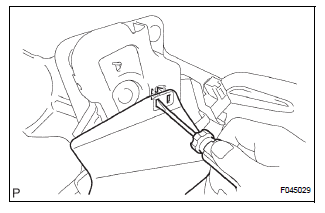
(a) Using a flat-head screwdriver, disengage the 2 claws on the parking brake pedal bracket protector.
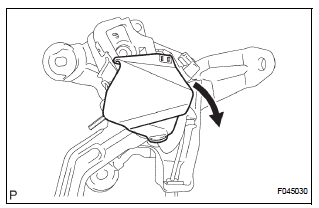
(b) Turning the parking brake pedal bracket protector clockwise, remove the parking brake pedal bracket protector from the parking brake control pedal.
2. REMOVE PARKING BRAKE CABLE ASSEMBLY NO.1
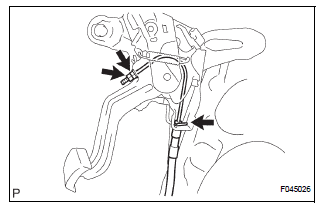
(a) Remove the lock nut, adjusting nut, clip and disconnect the parking brake cable assembly No. 1 from the parking brake control pedal assembly.
(b) Take up the floor carpet.
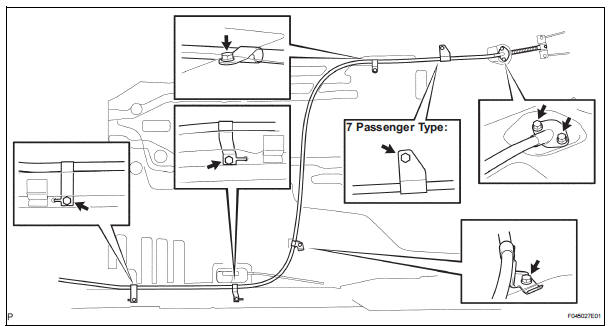
(c) Remove the 6 bolts and disconnect the parking brake cable assembly No. 1 from the floor. (Except 7 Passenger Type) (d) Remove the 7 bolts and disconnect the parking brake cable assembly No. 1 from the floor. (7 Passenger Type) (e) Disconnect the parking brake cable No. 1 from the parking brake equalizer, and remove the parking brake cable No. 1.
3. REMOVE PARKING BRAKE SWITCH ASSEMBLY
(a) Remove the screw and parking brake switch.
 Removal
1. DISCONNECT BATTERY NEGATIVE TERMINAL
2. REMOVE FRONT DOOR SCUFF PLATE LH
3. REMOVE COWL SIDE TRIM BOARD LH
4. REMOVE INSTRUMENT PANEL FINISH PANEL SUBASSEMBLY
LOWER LH (See page IP-6)
5. REMOV ...
 Reassembly
1. INSTALL PARKING BRAKE SWITCH ASSEMBLY
(a) Install the parking brake switch to the parking brake
pedal with the screw.
2. INSTALL PARKING BRAKE CABLE ASSEMBLY NO.1
(a) Connect the parking brake ...
Other materials:
Front Occupant Classification Sensor LH Circuit
Malfunction
DTC B1780 Front Occupant Classification Sensor LH Circuit
Malfunction
DESCRIPTION
The front occupant classification sensor LH circuit consists of the occupant
classification ECU and the
front occupant classification sensor LH.
DTC B1780 is recorded when a malfunction is detected in the fron ...
Master cylinder pressure sensor check (when using intelligent tester)
(a) Leave the vehicle in a stationary condition and
release the brake pedal for 1 second or more, and
quickly depress the brake pedal with a force of 98 N
(10 kgf, 22 lbf) or more for 1 second or more.
(b) Check the ABS warning light stays on for 3
seconds
HINT:
Ensure that the ABS warni ...
On-vehicle inspection
1. INSPECT STEERING PAD (VEHICLE NOT INVOLVED IN COLLISION)
Perform a diagnostic system check.
With the steering pad installed on the vehicle,
perform a visual check. If there are any defects as
mentioned below, replace the steering pad with a
new one:
Cuts, minute cracks or ...
