
Toyota Sienna Service Manual: Inspection
1. INSPECT THERMOSTAT
(a) Inspect the thermostat.
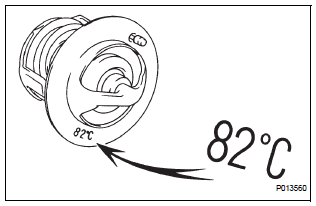
HINT: The valve opening temperature is inscribed on the thermostat.
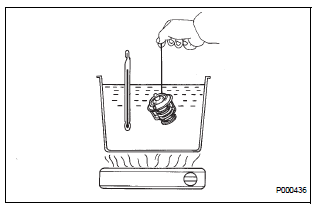
(b) Immerse the thermostat in water and gradually heat the water.
(c) Check the valve opening temperature.
Valve opening temperature: 80 to 84°C (176 to 183°F) If the valve opening temperature is not as specified, replace the thermostat.
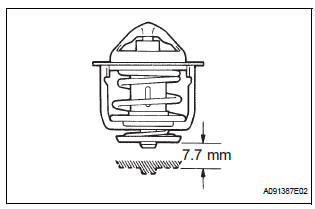
(d) Check the valve lift.
Valve lift: 7.7 mm (0.303 in.) or more at 95°C (203°F) If the valve lift is not as specified, replace the thermostat.
(e) Check that the valve is fully closed when the thermostat is at low temperatures (below 40°C (104°F)).
If it is not fully closed, replace the thermostat.
 Removal
1. REMOVE V-BANK COVER SUB-ASSEMBLY (See
page EM-28)
2. REMOVE NO. 1 ENGINE UNDER COVER (See page
EM-26)
3. DRAIN ENGINE COOLANT (See page CO-6)
4. REMOVE FRONT WHEEL RH
5. REMOVE FRONT FENDER A ...
 Installation
1. Install thermostat
(a) Install a new gasket to the thermostat.
(b) Install the thermostat with the jiggle valve facing up.
Hint:
the jiggle valve may be set within 10° on either side
of ...
Other materials:
Rear Airbag Sensor RH Circuit Malfunction
DTC B1154/38 Rear Airbag Sensor RH Circuit Malfunction
DESCRIPTION
The rear airbag sensor RH circuit consists of the center airbag sensor
assembly and rear airbag sensor
RH.
If the center airbag sensor assembly receives signals from the rear airbag
sensor RH, it judges whether or
not the ...
Installation
1. INSTALL SHOCK ABSORBER ASSEMBLY REAR LH
(a) Install the rear spring bumper No.1 LH to the shock
absorber assembly LH.
(b) Support the rear axle beam assembly with a jack.
(c) Install the rear shock absorber assembly rear LH,
cushion retainer and nut to the rear axle beam.
(d) ...
Short to B+ in Rear Curtain Shield Squib LH
Circuit
DTC B1638/86 Short to B+ in Rear Curtain Shield Squib LH
Circuit
DESCRIPTION
The rear curtain shield squib LH circuit consists of the center airbag sensor
assembly and the curtain
shield airbag assembly LH.
The circuit instructs the SRS to deploy when deployment conditions are met.
DTC B ...
