
Toyota Sienna Service Manual: Bluetooth tel check mode
HINT: Illustration may differ from the actual vehicle depending on the device settings and options. Therefore, some detailed area may not be shown exactly the same as on the actual vehicle.
1. ENTER DIAGNOSTIC MODE
2. BLUETOOTH TEL CHECK
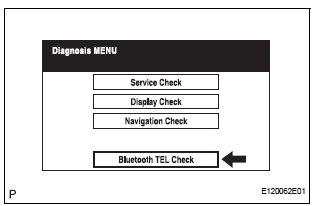
- Select "Bluetooth TEL Check" from the "Diagnosis MENU" screen.
3. BLUETOOTH CHECK
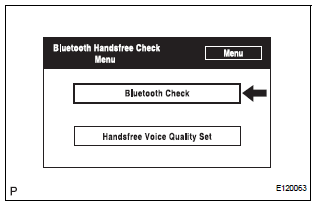
- Select "Bluetooth Check" from the "Bluetooth Handsfree Check Menu" screen
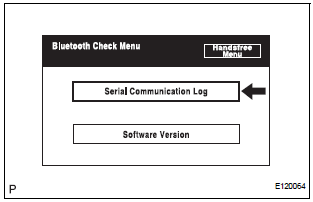
- Select "Serial Communication Log" from the "Bluetooth Check Menu" screen.
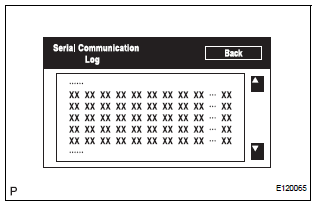
- The communication log data in the display ECU are displayed on this screen.
HINT: The displayed data can be used as a reference.
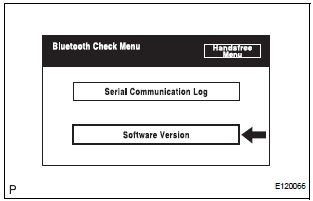
- Select "Software Version" from the "Bluetooth Check Menu" screen.
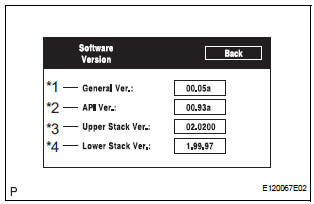
- Check the software version of the Bluetooth module.
Screen Description:
|
Display |
Contents |
| General Version / *1 |
|
| API Version / *2 | API software version is displayed. |
| Upper Stack Version / *3 | Upper Stack version is displayed |
| Lower Stack Version / *4 | Lower Stack version is displayed. |
HINT: This function is controlled by the built-in display ECU.
4. HANDSFREE VOICE QUALITY SET
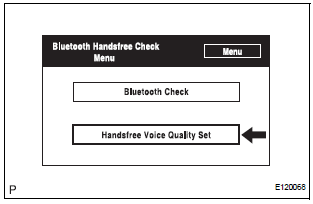
- Select "Handsfree Voice Quality Set" from the "Bluetooth Handsfree check Menu" screen.
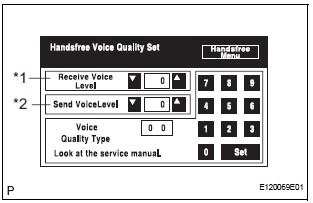
- Check the handsfree voice level.
Screen Description:
|
Display |
Contents |
| Received voice level adjustment / *1 | Setting possible for the voice level received from Bluetooth compatible phones. |
| Sent voice level adjustment / *2 | Setting possible for the voice set to Bluetooth compatible phones. |
HINT: This function is controlled by the built-in display ECU.
NOTICE: "Voice Quality Type" should not be changed.
 Display check mode
HINT:
This mode checks the color display on the display.
Illustrations may differ from the actual vehicle depending
on the device settings and options. Therefore, some
detailed a ...
 Navigation check mode
HINT:
This mode displays GPS satellite information.
Illustrations may differ from the actual vehicle depending
on the device settings and options. Therefore, some
detailed areas ...
Other materials:
Removal
1. DRAIN AUTOMATIC TRANSAXLE FLUID (See page
AX-131)
2. REMOVE NO. 1 TRANSFER CASE PLUG (See page
TF-8)
3. REMOVE TRANSFER DRAIN PLUG
(a) Remove the transfer drain plug, gasket and bleed
the drain transfer oil.
4. REMOVE FRONT WHEEL
5. REMOVE FRONT DRIVE SHAFT ASSEMBLY RH
HINT:
(See page D ...
Removal
HINT:
Use the same procedures for the RH side and LH side.
The procedures listed below are for the LH side.
1. PRECAUTION
CAUTION:
Be sure to read "PRECAUTION" thoroughly before
servicing.
2. DISCONNECT CABLE FROM NEGATIVE BATTERY
TERMINAL
CAUTION:
Wait for 90 s ...
Reassembly
1. INSTALL INSTR PNL PASS L/DOOR AIR BAG
ASSEMBLY
2. INSTALL INSTRUMENT PANEL WIRE NO.2
3. INSTALL NAVIGATION ANTENNA ASSEMBLY
4. INSTALL ANTENNA CORD SUB-ASSEMBLY
5. INSTALL INSTRUMENT PANEL BOX DOOR SUBASSEMBLY
NO.2
6. INSTALL INSTRUMENT PANEL FINISH PANEL
RETAINER NO.1
7. INSTALL INSTRUM ...
