
Toyota Sienna Service Manual: Throttle Actuator Control Motor Circuit
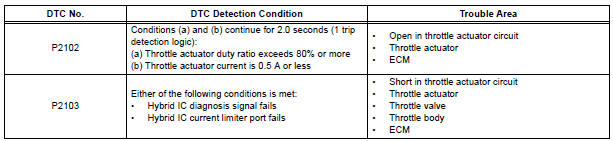
DTC P2102 Throttle Actuator Control Motor Circuit Low
DTC P2103 Throttle Actuator Control Motor Circuit High
DESCRIPTION
The throttle actuator is operated by the ECM and opens and closes the throttle valve using gears.
The opening angle of the throttle valve is detected by the Throttle Position (TP) sensor, which is mounted on the throttle body. The TP sensor provides feedback to the ECM. This feedback allows the ECM to appropriately control the throttle actuator and monitor the throttle opening angle as the ECM responds to driver inputs.
HINT: This ETCS (Electronic Throttle Control System) does not use a throttle cable.
MONITOR DESCRIPTION
The ECM monitors the electrical current through the electronic actuator, and detects malfunctions and open circuits in the throttle actuator based on this value. If the current is outside the standard range, the ECM determines that there is a malfunction in the throttle actuator. In addition, if the throttle valve does not function properly (for example, stuck on), the ECM determines that there is a malfunction. The ECM then illuminates the MIL and sets a DTC.
Example: When the electrical current is more than 10 A, or less than 0.5 A and the throttle actuator duty ratio exceeds 80%, the ECM interprets this as the current being outside the standard range, and illuminates the MIL and sets a DTC.
If the malfunction is not repaired successfully, a DTC is set when the engine is quickly revved up to a high rpm several times after the engine has idled for 5 seconds after engine start.
MONITOR STRATEGY
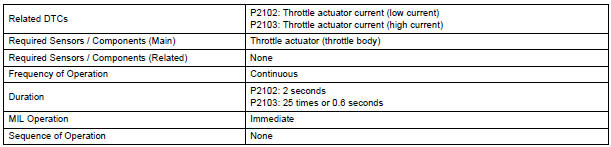
TYPICAL ENABLING CONDITIONS
All:

P2102:

P2103:

TYPICAL MALFUNCTION THRESHOLDS
P2102:

P2103:

FAIL-SAFE
When either of these DTCs, as well as other DTCs relating to ETCS (Electronic Throttle Control System) malfunctions, is set, the ECM enters fail-safe mode. During fail-safe mode, the ECM cuts the current to the throttle actuator off, and the throttle valve is returned to a 6 throttle angle by the return spring. The ECM then adjusts the engine output by controlling the fuel injection (intermittent fuel-cut) and ignition timing, in accordance with the accelerator pedal opening angle, to allow the vehicle to continue at a minimal speed.
If the accelerator pedal is depressed gently, the vehicle can be driven slowly.
Fail-safe mode continues until a pass condition is detected, and the ignition switch is then turned off.
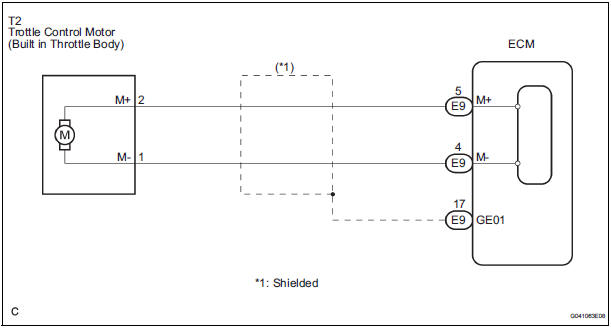
WIRING DIAGRAM
INSPECTION PROCEDURE
HINT:
- Read freeze frame data using the intelligent tester. The ECM records vehicle and driving condition information as freeze frame data the moment a DTC is stored. When troubleshooting, freeze frame data can be helpful in determining whether the vehicle was running or stopped, whether the engine was warmed up or not, whether the air-fuel ratio was lean or rich, as well as other data recorded at the time of a malfunction.
- The throttle actuator current (THROTTLE MOT) and the throttle actuator duty ratio (THROTTLE OPN / THROTTLE CLS) can be read using the intelligent tester. However, the ECM shuts off the throttle actuator current when the ETCS malfunctions.
1 INSPECT THROTTLE BODY (RESISTANCE OF THROTTLE CONTROL MOTOR)
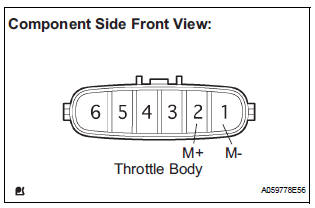
- Disconnect the T2 throttle body connector.
- Measure the resistance according to the value(s) in the table below.
Standard resistance

- Reconnect the throttle body connector
2 CHECK HARNESS AND CONNECTOR (THROTTLE CONTROL MOTOR - ECM)
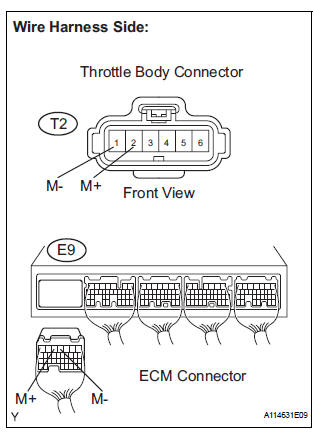
- Disconnect the T2 throttle body connector.
- Disconnect the E9 ECM connector.
- Measure the resistance according to the value(s) in the table below.
Standard resistance : Check for open

Check for short

- Reconnect the throttle body connector.
- Reconnect the ECM connector.
3 INSPECT THROTTLE BODY
- Check for foreign objects between the throttle valve and the housing.
OK: Normal
4 INSPECT THROTTLE VALVE
- Check if the throttle valve opens and closes smoothly.
OK: The throttle valve opens and closes smoothly.
REPLACE ECM
 Transmission Range Sensor Circuit Malfunction
(PRNDL Input)
Transmission Range Sensor Circuit Malfunction
(PRNDL Input)
DTC P0705 Transmission Range Sensor Circuit Malfunction
(PRNDL Input)
DESCRIPTION
The park/neutral position switch detects the shift lever position and sends
signals to the ECM.
HINT:
After ...
 Throttle Actuator Control System
DTC P2111 Throttle Actuator Control System - Stuck Open
DTC P2112 Throttle Actuator Control System - Stuck
Closed
DESCRIPTION
The throttle actuator is operated by the ECM, and opens and closes the ...
Other materials:
Inspection
1. INSPECT INVERTER MAIN SWITCH
Inspect the continuity between terminal at the each
switch position shown in the chart.
If continuity is not as specified, replace the main
switch assembly.
Inspect the bulb state when connecting the battery
to each terminal
...
Rear Airbag Sensor RH Circuit Malfunction
DTC B1154/38 Rear Airbag Sensor RH Circuit Malfunction
DESCRIPTION
The rear airbag sensor RH circuit consists of the center airbag sensor
assembly and rear airbag sensor
RH.
If the center airbag sensor assembly receives signals from the rear airbag
sensor RH, it judges whether or
not the ...
Installation
1. INSTALL CENTER REAR SEAT LAP TYPE BELT
ASSEMBLY (for 8-Passenger)
HINT:
Refer to the instructions for reassembly of the rear No. 1
seat assembly (for center seat).
Install the center rear seat lap type belt assembly
with the bolt.
Torque: 42 N*m (430 kgf*cm, 31 ft.*lbf)
2. IN ...
