
Toyota Sienna Service Manual: Disassembly
1. REMOVE GENERATOR CLUTCH PULLEY
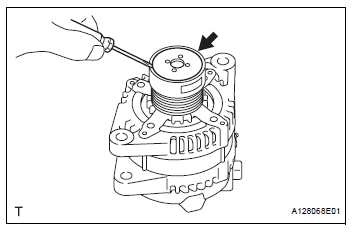
(A) using a screwdriver, remove the generator pulley cap.
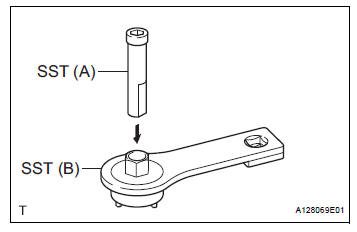
(b) Set SST (A) and (B).
SST 09820-63020
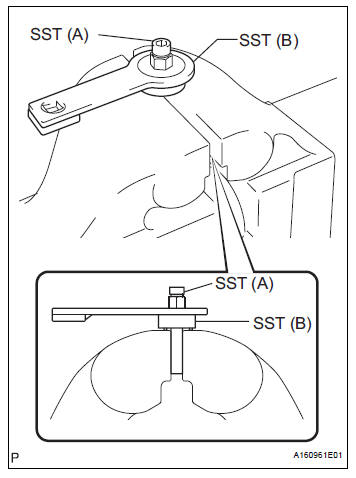
(c) Clamp SST (A) in a vise.
| NOTICE: Be sure to fix the flat surface of SST (A) in a vise. |
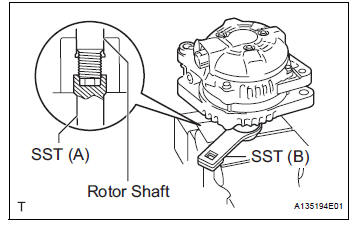
(d) Place the rotor shaft end into SST (A).
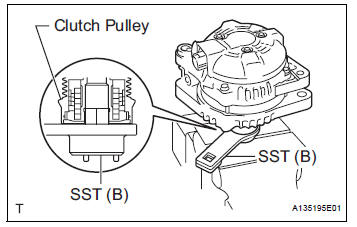
(e) Fit SST (B) to the clutch pulley.
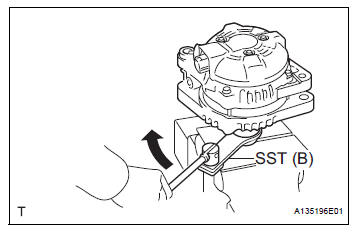
(f) Loosen the pulley by turning SST (B) in the direction shown in the illustration.
| NOTICE: Hold the generator assembly tightly. |
(g) Remove the generator assembly from SST.
(h) Remove the clutch pulley from the rotor shaft.
2. REMOVE GENERATOR REAR END COVER
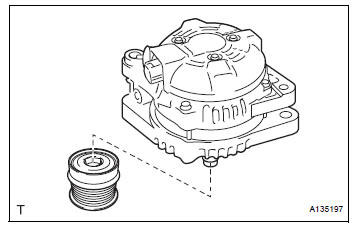
(a) Place the generator assembly on the clutch pulley.
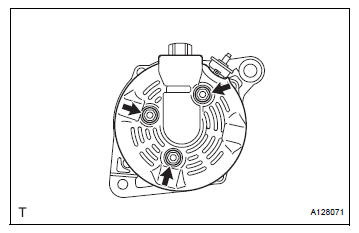
(b) Remove the 3 nuts and generator rear end cover.
3. REMOVE GENERATOR TERMINAL INSULATOR
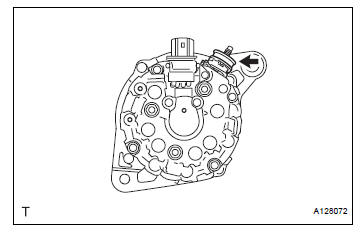
(a) Remove the terminal insulator from the generator coil.
4. REMOVE GENERATOR BRUSH HOLDER ASSEMBLY
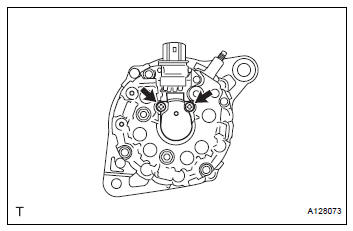
(a) Remove the 2 screws and brush holder from the generator coil.
5. REMOVE GENERATOR COIL ASSEMBLY
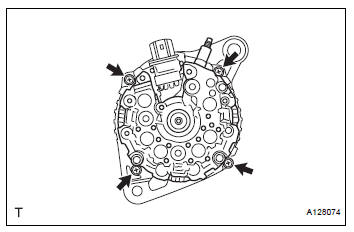
(a) Remove the 4 bolts.
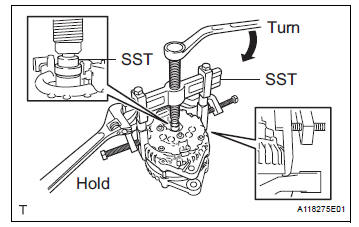
(b) Using SST, remove the generator coil assembly.
SST 09950-40011 (09951-04020, 09952-04010, 09953-04020, 09954-04010, 09955-04071, 09957-04010, 09958-04011)
6. REMOVE GENERATOR ROTOR ASSEMBLY
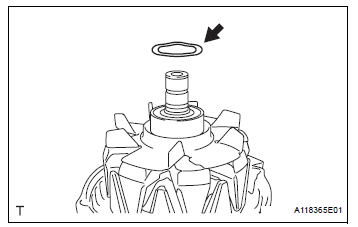
(a) Remove the generator washer.
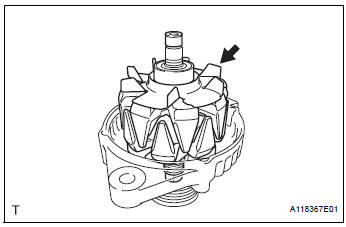
(b) Remove the generator rotor assembly.
 Removal
1. Remove v-bank cover sub-assembly (see
page em-28)
2. Remove front wheel rh
3. Remove no. 1 Engine under cover (see page
em-26)
4. Remove front fender apron seal rh (see
page em-26)
5. Drain ...
 Inspection
1. Inspect generator clutch pulley
(a) Hold the center of the pulley, and confirm that the
outer ring turns counterclockwise and does not turn
clockwise.
If the result is not as specified, r ...
Other materials:
Components
REMOVAL
1. DISCONNECT CABLE FROM NEGATIVE BATTERY
TERMINAL
2. REMOVE FRONT BUMPER ASSEMBLY
3. REMOVE FOG LIGHT ASSEMBLY
Disengage the 2 claws
Disengage the 2 pins and remove the fog light
assembly.
DISASSEMBLY
1. REMOVE FOG LIGHT BULB
Turn in the dir ...
Operating the HomeLink
Press the appropriate HomeLink® button. The HomeLink® indicator
light on the HomeLink® transceiver should turn on.
The HomeLink® continues to send a signal for up to 20 seconds as long as
the button is pressed.
Reprogramming a HomeLink® button
Press and hold the desired HomeLink® button ...
VC Output Circuit
DESCRIPTION
The ECM constantly uses 5 V from the battery voltages supplied to the +B (BATT)
terminal to operate the
microprocessor. The ECM also provides this power to the sensors through the VC
output circuit.
When the VC circuit is short-circuited, the microprocessor in the ECM and
sens ...
