
Toyota Sienna Service Manual: ECM Power Source Circuit
DESCRIPTION
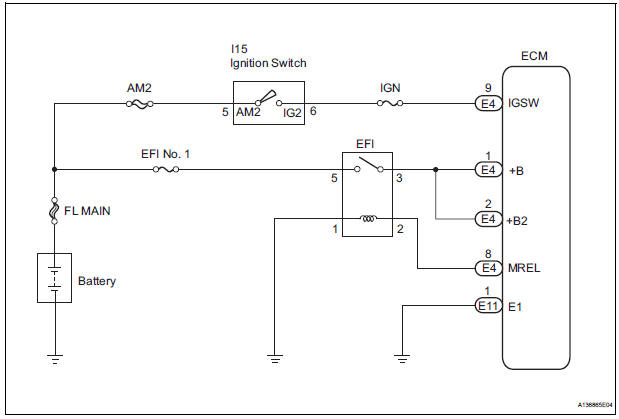
When the ignition switch is turned to the ON position, the battery voltage is applied to terminal IGSW of the ECM. The ECM MREL output signal causes a current to flow to the coil, closing the contacts of the EFI relay and supplying power to terminal +B of the ECM.
If the ignition switch is turned off, the ECM holds the EFI relay ON for a maximum of 2 seconds to allow for the initial setting of the throttle valve.
WIRING DIAGRAM
INSPECTION PROCEDURE
1 INSPECT ECM (+B VOLTAGE)
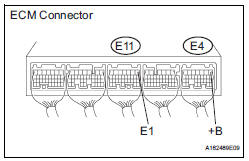
(a) Turn the ignition switch to the ON position.
(b) Measure the voltage according to the value(s) in the table below.
Standard voltage 


2 CHECK HARNESS AND CONNECTOR (ECM - BODY GROUND)
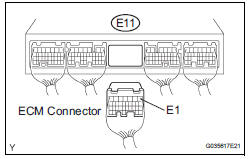
(a) Disconnect the E11 ECM connector.
(b) Measure the resistance according to the value(s) in the table below.
Standard resistance: 
(c) Reconnect the ECM connector.


3 INSPECT ECM (IGSW VOLTAGE)
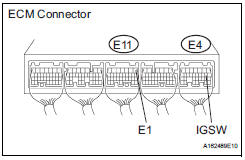
(a) Turn the ignition switch to the ON position.
(b) Measure the voltage according to the value(s) in the table below
Standard voltage 


4 CHECK FUSE (IGN FUSE)
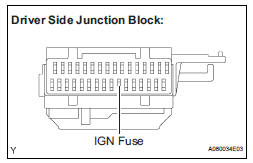
(a) Remove the IGN fuse from the driver side junction block.
(b) Measure the IGN fuse resistance.
Standard resistance: Below 1 Ω
(c) Reinstall the IGN fuse.


5 CHECK HARNESS AND CONNECTOR (IGNITION SWITCH - ECM)
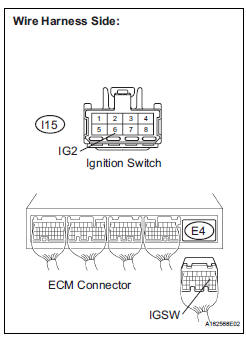
(a) Disconnect the E4 ECM connector.
(b) Disconnect the I15 ignition switch connector.
(c) Measure the resistance according to the value(s) in the table below.
Standard resistance: 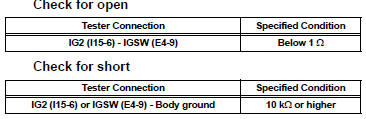
(d) Reconnect the ECM connector.
(e) Reconnect the ignition switch connector.


6 INSPECT IGNITION SWITCH ASSEMBLY
(a) Inspect the ignition or starter switch assembly (See page ST-16).


7 CHECK FUSE (AM2 FUSE)
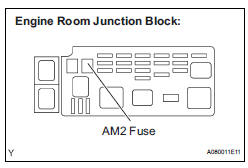
(a) Remove the AM2 fuse from the engine room junction block.
(b) Measure the resistance according to the value(s) in the table below.
Standard resistance: Below 1 Ω
(c) Reinstall the AM2 fuse


REPAIR OR REPLACE HARNESS OR CONNECTOR (IGNITION SWITCH - BATTERY)
8 INSPECT ECM (MREL VOLTAGE)
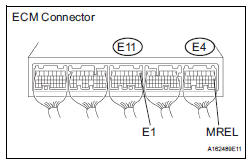
(a) Turn the ignition switch to the ON position.
(b) Measure the voltage according to the value(s) in the table below.
Standard voltage 


9 CHECK FUSE (EFI NO.1 FUSE)
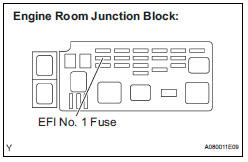
(a) Remove the EFI No. 1 fuse from the engine room junction block.
(b) Measure the EFI No. 1 fuse resistance.
Standard resistance: Below 1 Ω
(c) Reinstall the EFI No. 1 fuse.


10 INSPECT RELAY (EFI RELAY)
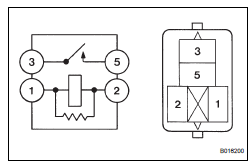
(a) Remove the EFI relay from the engine room junction block.
(b) Measure the EFI relay resistance.
Standard resistance 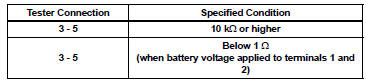
(c) Reinstall the EFI relay.


11 CHECK HARNESS AND CONNECTOR (EFI RELAY - ECM)
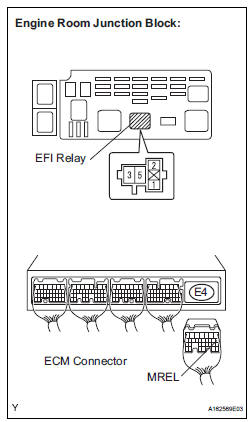
(a) Check the harness and connector between the EFI relay and ECM.
(1) Remove the EFI relay from the engine room junction block.
(2) Disconnect the E4 ECM connector.
(3) Measure the resistance according to the value(s) in the table below.
Standard resistance: 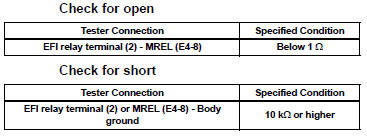


12 CHECK HARNESS AND CONNECTOR (EFI RELAY - ECM)
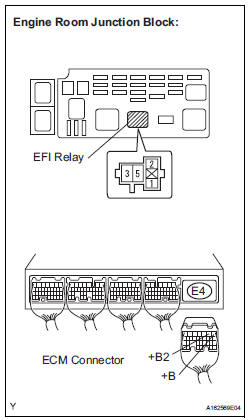
(a) Remove the EFI relay from the engine room junction block.
(b) Disconnect the E4 ECM connector.
(c) Measure the resistance according to the value(s) in the table below.
Standard resistance: 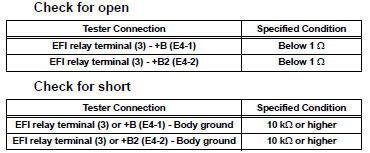
(d) Reinstall the EFI relay.
(e) Reconnect the ECM connector.


13 CHECK HARNESS AND CONNECTOR (EFI RELAY - BODY GROUND)
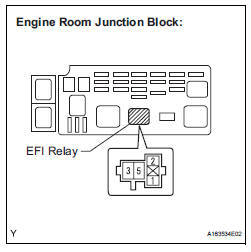
(a) Check the harness and connector between the EFI relay and body ground.
(1) Measure the resistance according to the value(s) in the table below.
Standard resistance : 
(2) Reinstall the EFI relay.
(3) Reconnect the ECM connector.


REPAIR OR REPLACE HARNESS OR CONNECTOR (EFI RELAY - BATTERY)
 EVAP System
RELATED DTCS
If any EVAP system DTCs are set, the malfunctioning area can be determined
using the table below.
NOTICE:
If the 0.02 inch reference pressure difference between the ...
 VC Output Circuit
DESCRIPTION
The ECM constantly uses 5 V from the battery voltages supplied to the +B
(BATT) terminal to operate the
microprocessor. The ECM also provides this power to the sensors through the VC
...
Other materials:
Short in Side Squib RH Circuit
DTC B0110/43 Short in Side Squib RH Circuit
DESCRIPTION
The side squib RH circuit consists of the center airbag sensor assembly and
the front seat side airbag
assembly RH.
The circuit instructs the SRS to deploy when deployment conditions are met.
DTC B0110/43 is recorded when a short cir ...
Terminals of ECU
1. CHECK OUTER MIRROR CONTROL ECU LH
Disconnect the O9 and O10 connectors.
Measure the voltage and resistance according to
the value(s) in the table below.
Voltage
Resistance
If the result is not as specified, there may be a
malfunction on the wire harness side.
Recon ...
Short to GND in Rear Curtain Shield Squib RH
Circuit
DTC B1632/81 Short to GND in Rear Curtain Shield Squib RH
Circuit
DESCRIPTION
The rear curtain shield squib RH circuit consists of the center airbag sensor
assembly and the curtain
shield airbag assembly RH.
The circuit instructs the SRS to deploy when deployment conditions are met.
DTC ...
