
Toyota Sienna Service Manual: MIL Circuit
DESCRIPTION
The MIL (Malfunction Indicator Lamp) is used to indicate vehicle malfunctions detected by the ECM.
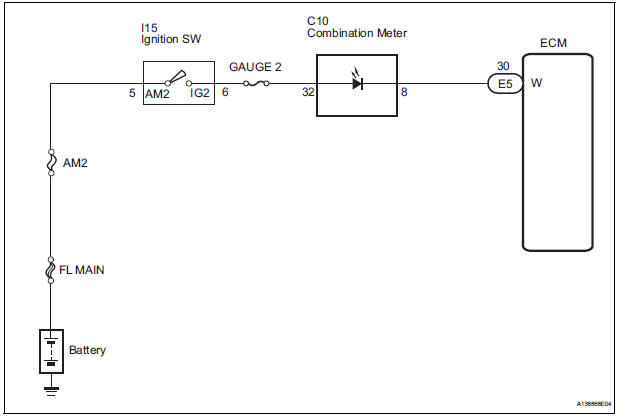
When the ignition switch is turned to the ON position, power is supplied to the MIL circuit, and the ECM provides the circuit ground which illuminates the MIL.
The MIL operation can be checked visually. When the ignition switch is first turned to the ON position, the MIL should be illuminated and should then turn off. If the MIL remains illuminated or is not illuminated, conduct the following troubleshooting procedure using the intelligent tester.
WIRING DIAGRAM
INSPECTION PROCEDURE
1 CHECK THAT MIL IS ILLUMINATED
(a) Turn the ignition switch to the ON position.
(b) Check the illumination of the MIL.
Result


2 CHECK WHETHER MIL TURNS OFF
(a) Connect the intelligent tester to the DLC3.
(b) Turn the ignition switch to the ON position and turn the tester on.
(c) Select the following menu items: DIAGNOSIS / ENHANCED OBD II / DTC INFO / CURRENT CODES.
(d) Check if any DTCs have been stored. Note down any DTCs.
(e) Clear the DTCs (See page ES-39).
(f) Check if the MIL goes off.
Standard: MIL goes off.


3 CHECK HARNESS AND CONNECTOR (CHECK FOR SHORT IN WIRE HARNESS)
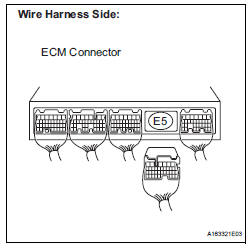
(a) Disconnect the E5 ECM connector.
(b) Turn the ignition switch to the ON position.
(c) Check that the MIL is not illuminated.
OK: MIL is not illuminated.
(d) Reconnect the ECM connector.


4 CHECK HARNESS AND CONNECTOR (COMBINATION METER - ECM)
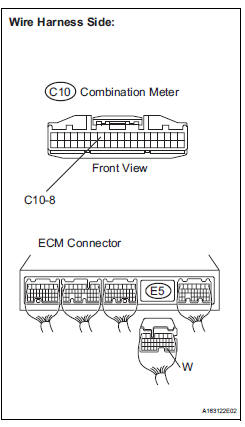
(a) Disconnect the E5 ECM connector.
(b) Disconnect the C10 combination meter connector.
(c) Measure the resistance according to the value(s) in the table below.
Standard resistance (Check for Open)
Standard resistance (Check for Short)
(d) Reconnect the ECM connector.
(e) Reconnect the combination meter connector.


REPAIR OR REPLACE HARNESS OR CONNECTOR (COMBINATION METER - ECM)
5 CHECK THAT ENGINE STARTS
(a) Turn the ignition switch to the ON position.
(b) Start the engine.
Result
HINT: *: The intelligent tester cannot communicate with the ECM.


6 CHECK HARNESS AND CONNECTOR (COMBINATION METER - BODY GROUND)
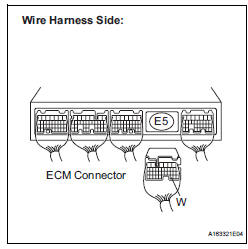
(a) Disconnect the E5 ECM connector.
(b) Turn the ignition switch to the ON position.
(c) Measure the voltage according to the value(s) in the table below.
Standard voltage 
(d) Reconnect the ECM connector.


7 CHECK HARNESS AND CONNECTOR (COMBINATION METER - ECM)
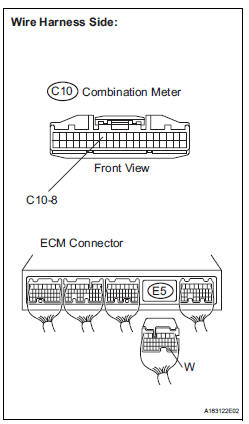
(a) Disconnect the E5 ECM connector.
(b) Disconnect the C10 combination meter connector.
(c) Measure the resistance according to the value(s) in the table below.
Standard resistance (Check for short)

Standard resistance (Check for Short)

(d) Reconnect the ECM connector.
(e) Reconnect the combination meter connector


REPLACE COMBINATION METER ASSEMBLY
 Air Intake Control Circuit
DESCRIPTION
The air cleaner is equipped with two inlets, one of which is opened or closed
by the Air Intake Control
Valve (AICV). This system reduces intake noise and increases engine power at
l ...
 Сamshaft timing oil control valve assembly
COMPONENTS
ON-VEHICLE INSPECTION
1. INSPECT CAMSHAFT TIMING CONTROL VALVE ASSEMBLY
(a) Connect the intelligent tester to the DLC3.
(b) Turn the ignition switch to the ON position ...
Other materials:
Tire Pressure Warning Reset Switch Circuit
DESCRIPTION
The ECU enters the initialization mode and performs initialization
automatically, when the tire pressure
warning ECU receives the signal from the tire pressure warning reset switch. If
the ECU receives the
signal, the tire pressure warning light blinks 3 times (1 second on, 1 seco ...
Other functions
Switching between outside air and recirculated air modes
Press .
The mode switches between outside air mode (
appears on the
display) and recirculated air mode (
appears on the display) each
time the button is pressed.
Defogging the windshield
Defoggers are used to defog the windshield a ...
ACIS Control Circuit
DESCRIPTION
This circuit opens and closes the Intake Air Control Valve (IACV) in response
to changes in the engine
load in order to increase the intake efficiency (ACIS: Acoustic Control
Induction System).
When the engine speed is between 0 and 4450 rpm and the throttle valve opening
angl ...
